
Workflow automation
Published August 10, 2026
There is no single best low-code platform for every business. In 2026, the right choice depends on how quickly a platform can turn business processes into working applications, how easily those applications can be adapted without coding, and how effectively it uses artificial intelligence throughout both application design and everyday business operations. Among the best-known low-code platforms today are Microsoft Power Apps, Mendix, OutSystems, Appian, Retool, and Tabidoo. Each offers different strengths and is designed for different types of organizations.
Author Tabidoo
17 minutes to read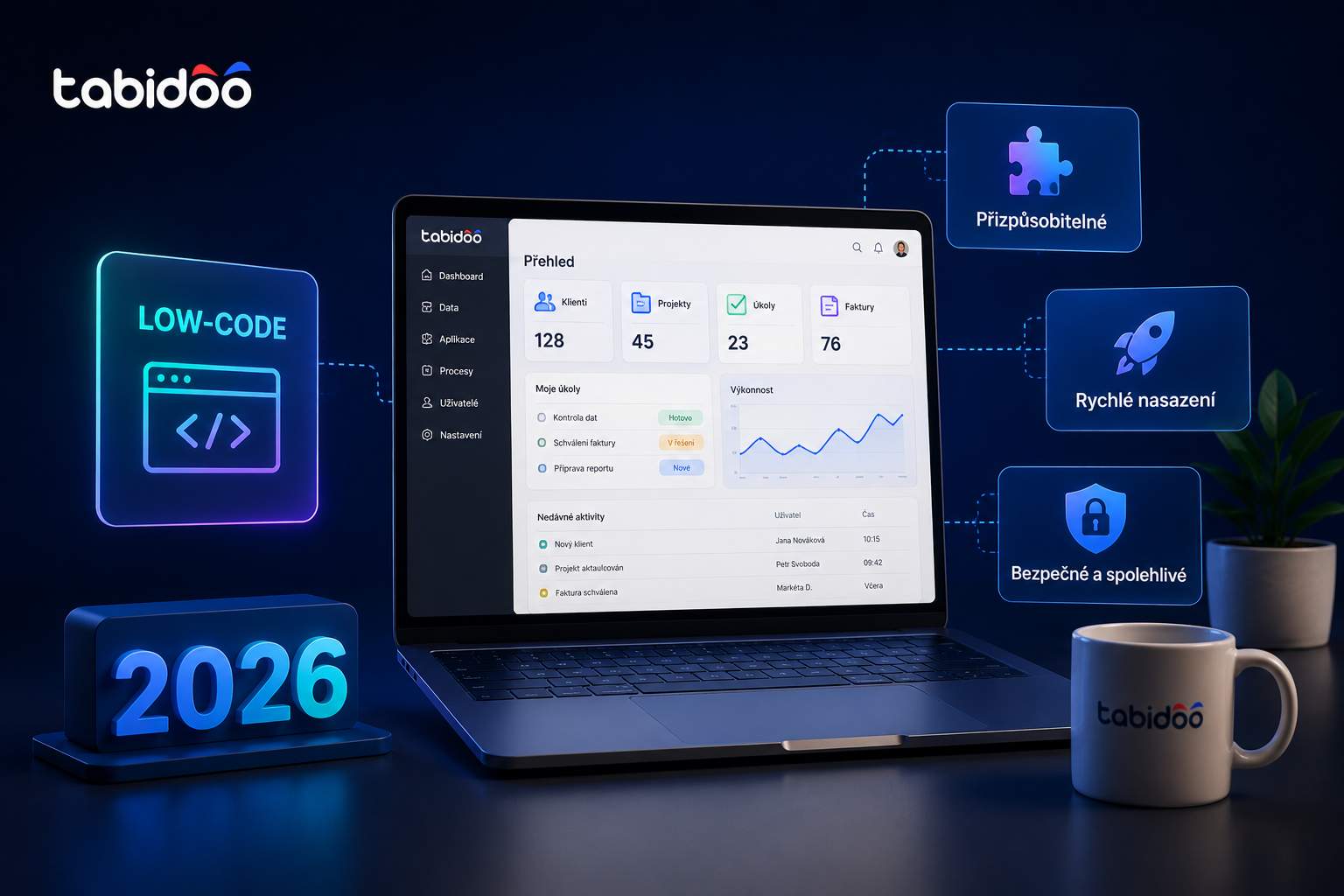
Today, choosing a platform is no longer just about the number of features. A modern low-code platform should support rapid change, centralized business data, process automation, and increasingly, AI-powered capabilities. Companies are no longer looking for software alone—they are looking for a platform that can evolve alongside their business.
Only a few years ago, building business applications was almost entirely the responsibility of software developers. Even a small change required a new specification, development time, testing, and often an additional budget. For many companies, it was easier to adapt their processes to existing software than to build software around the way they actually worked.
Today, that has changed.
Businesses operate in an environment that evolves faster than ever before. Regulations change, business models evolve, customer expectations continue to rise, and employees need instant access to information. Software can no longer be a static solution updated every few years. It has to evolve at the same pace as the business itself.
That is exactly why demand for low-code platforms continues to grow. They enable organizations to build custom business applications without lengthy development cycles, respond quickly to changing requirements, and digitize processes step by step according to current business needs.
This is not only about reducing costs.
The real advantage is the ability to respond to change in days instead of months.
When people think of artificial intelligence, they usually imagine chatbots or content generation tools. But in the world of low-code platforms, something much more significant is happening.
AI is now helping design applications themselves. Instead of worrying about databases, forms, or workflow structures, companies can simply describe the business problem they want to solve.
For example: „We need an application to manage service jobs. Once the technician completes the work, they upload photos, the customer signs a service report, and the manager approves invoicing.”
Just a few years ago, this would have required several meetings with business analysts and developers. Today, AI can generate the first version of the application within minutes.
It can recommend the data model, suggest forms, design workflows, create automations, and even prepare dashboards. The role of people then shifts from designing the application to validating whether it truly reflects how the business operates.
This is the biggest transformation of 2026. Low-code is no longer simply a way to build applications without programming. It has become a way to design applications faster—with AI as a partner throughout the process.
A few years ago, the number of available features was often the deciding factor.
Today, businesses ask very different questions.
This is why the best low-code platforms are no longer competing based on the number of forms or visual components they offer.
They compete on how effectively they support the day-to-day operations of a business.
That is where the difference becomes clear between a platform that simply allows you to build applications and one that becomes the long-term foundation for your company’s digital transformation.
The terms low-code and no-code are often used interchangeably, but they represent two different approaches to application development.
No-code platforms are designed for users with no programming experience. Applications are built using visual interfaces, drag-and-drop components, and configuration instead of code.
Low-code platforms take this a step further. Like no-code tools, they offer visual development environments, but they also allow developers to extend applications with custom code, advanced integrations, and more sophisticated business logic. This makes them suitable for both simple internal tools and enterprise-grade business applications.
| Low-code | No-code |
|---|---|
| Supports custom development | No programming required |
| Greater flexibility | Maximum simplicity |
| Suitable for enterprise projects | Ideal for business users |
| Advanced integrations | Fast internal applications |
| Scales as your business grows | Quick deployment without IT |
In practice, the distinction between the two is becoming less important. Modern platforms increasingly combine the simplicity of no-code with the flexibility of low-code, while AI makes both approaches significantly easier to use.
There are dozens of low-code platforms available today. Each was built with different priorities and serves different types of businesses.
Rather than looking for the “best” platform overall, companies should focus on finding the platform that best matches their business processes, growth plans, and internal capabilities.
Microsoft Power Apps is one of the world’s most widely used low-code platforms.
Its biggest advantage is its deep integration with the Microsoft ecosystem, including Microsoft 365, Dynamics 365, Power BI, and Power Automate.
Organizations already using Microsoft technologies can build applications quickly while leveraging existing users, permissions, and business data.
Mendix has established itself as one of the leading enterprise low-code platforms.
It is designed primarily for large organizations building complex business applications that require high levels of security, governance, and scalability.
OutSystems is considered one of the pioneers of the low-code industry.
The platform enables organizations to build sophisticated enterprise applications while maintaining the flexibility to extend them through custom development when needed.
Appian focuses primarily on business process management (BPM), workflow automation, and enterprise process orchestration.
Its greatest strength lies in helping organizations digitize complex approval processes and operational workflows.
Retool is especially popular among technology companies and internal development teams.
It enables rapid creation of internal tools built on top of existing databases and APIs, making it an excellent choice for technical organizations.
Tabidoo takes a different approach. Instead of positioning itself as a universal development platform, it focuses on helping companies digitize their business processes quickly without long implementation projects or heavy reliance on software developers.
Using its visual editor, organizations can create CRM systems, project management applications, HR solutions, asset management systems, approval workflows, service management applications, and virtually any other internal business application tailored to their specific needs.
One of Tabidoo’s biggest strengths is that it combines multiple capabilities within a single platform:
Perhaps the biggest innovation is AI Partner. Rather than acting as a generic AI chatbot, it becomes part of the entire application lifecycle.
It helps design application structures, recommends data models, suggests workflows, assists with form creation, and later analyzes business data directly within applications built in Tabidoo.
As a result, AI becomes much more than another feature. It becomes an integral part of how business applications are designed, managed, and continuously improved.
Another important advantage is that Tabidoo does not charge per user, making it easier for growing organizations to scale usage across the entire company.
Instead of asking:„Which low-code platform is the best?” ask yourself: „What business challenges do we want to solve over the next five years?” The answer to that question is often far more valuable than any feature comparison.
Some organizations need enterprise-grade platforms capable of supporting hundreds of applications.
Others simply need an easier way to digitize sales, service management, HR, document approvals, or internal operations without depending on external software developers.
That is why there is no universally best low-code platform. There is only the platform that best matches the way your business works.
Choosing a low-code platform is not just a technology decision. In reality, you are deciding how your business will build applications, digitize processes, and respond to change for years to come.
Before comparing platforms, it is worth taking a step back and asking a few important questions.
One of the biggest mistakes companies make is asking: „What application do we need?” A much better question is: „What problem are we trying to solve?”
Do you want to speed up invoice approvals? Replace spreadsheets? Manage service jobs more efficiently Improve project visibility?Plan employee capacity? Only when you fully understand the process does it make sense to think about technology.
An application is not the goal. It is simply the tool that supports the way your business works.
Different users have different needs. A salesperson works differently from a field technician. An accountant needs different information than a project manager.
Before choosing a platform, ask yourself:
The better you understand your users, the easier it becomes to choose the right platform.
Many companies focus on designing attractive forms. In reality, the most valuable part of every application is its data.
Ask yourself:
A well-designed data model determines whether your application will still be useful years from now. Technology can always evolve. Poor data architecture becomes expensive to fix.
Business applications rarely exist in isolation.
Most companies need to connect their applications with other business systems, such as:
The quality of these integrations often determines how much work can actually be automated. Without connected data, automation quickly reaches its limits.
Business processes change constantly. Teams grow. Departments evolve. Products change. New legislation appears. That is why one of the most important questions is: „How difficult will it be to change this application next year?“
If every modification requires a new development project, weeks of waiting, or external developers, the platform may not be flexible enough for long-term growth.
The best low-code platforms are designed to evolve together with your business.
Choosing the wrong platform is rarely the biggest problem. Implementation is. The way a company approaches digital transformation has a much greater impact than the technology itself.
Technology does not automatically improve broken processes. If a process is inefficient today, building an application around it simply makes the same inefficiency digital. Before creating an application, review the process itself.
Only then should the process be digitized.
This happens surprisingly often. A company replaces spreadsheets and then recreates exactly the same spreadsheet inside a low-code platform.
But modern platforms offer far more than digital tables.
They provide:
If your new application behaves exactly like Excel, you are only using a fraction of what low-code platforms can offer.
Many organizations spend months trying to design the perfect system. In reality, successful low-code projects usually start much smaller. Build the first version. Let people use it. Collect feedback. Improve it continuously.
That is one of the biggest strengths of low-code platforms. Applications are not finished products. They evolve together with the business.
Technology alone is never enough. Every business application needs someone responsible for its long-term development.
Someone who:
Without ownership, even the best-designed application will gradually become outdated.
Imagine a company that installs air conditioning systems. The sales team manages opportunities in a CRM. Technicians schedule work in Excel. Photos are shared through WhatsApp. Accounting waits for email confirmation before invoicing. Operations keeps another spreadsheet. Every department has information. Nobody has the complete picture.
The company decides to build a custom application. A single database now stores every service job. Sales creates the order. The technician receives the task on a mobile device. After completing the work, they upload photos directly into the application. The system automatically notifies accounting. Managers see every active project in a real-time dashboard.
Within seconds, company leadership can answer questions such as:
The biggest improvement is not that the company introduced new software. It is that all business information finally works together inside one connected system.
There is no single best low-code platform for every business. The right choice depends on your company size, business processes, integration requirements, scalability, and how you plan to use AI. Some of the leading platforms include Microsoft Power Apps, Mendix, OutSystems, Appian, Retool, and Tabidoo.
No-code platforms allow users to build applications without writing code through visual interfaces and drag-and-drop components.
Low-code platforms offer the same visual development experience while also allowing developers to extend applications with custom code, advanced business logic, and complex integrations when needed.
In most business scenarios, no.
Modern low-code platforms enable business users to create applications using visual builders, workflows, and AI assistants. Developers are usually only required for highly specialized functionality or advanced integrations.
Simple internal applications can often be built within hours or days. More complex enterprise systems usually take several weeks.
With AI supporting application design and workflow creation, development time can be significantly reduced.
Organizations use low-code platforms to build a wide range of business applications, including:
The biggest advantage is flexibility.
Instead of adapting your business to standard software, you build software around the way your business already works.
AI can recommend data models, generate forms, design workflows, suggest automations, create dashboards, and analyze business data.
Rather than replacing people, AI speeds up the analytical and design phases of application development, allowing teams to move from idea to working solution much faster.
Excel works well until multiple people begin working with the same data, processes become difficult to manage, information is duplicated, approvals happen via email, or reporting becomes increasingly time-consuming.
At that point, a low-code platform provides centralized data, automated workflows, better collaboration, and complete visibility across the business.
Absolutely. Low-code platforms are no longer used only by large enterprises.
Small and medium-sized businesses increasingly rely on them to digitize processes without investing in expensive custom software development.
The ability to start small and expand applications over time makes low-code especially attractive for growing organizations.
Focus on long-term flexibility rather than the number of available features.
Look for a platform that supports:
The best platform is not the one with the longest feature list. It is the one that best supports the way your company works.
AI Partner is designed to support the entire lifecycle of a business application. It helps companies design applications by recommending data structures, forms, workflows, and automations.
Once the application is running, AI Partner continues to add value by searching company data, generating reports, analyzing business information, identifying opportunities for automation, and helping employees find answers faster.
Rather than acting as a generic chatbot, AI Partner understands the context of your business applications and works directly with your company’s data.
It depends on your business requirements. In many cases, a low-code platform complements existing ERP or CRM systems by covering business processes that standard software cannot easily support.
Some organizations also replace smaller legacy systems entirely with custom applications built on a low-code platform.
The role of AI will continue to expand. Instead of simply helping employees use applications, AI will increasingly participate in designing, testing, optimizing, and continuously improving them.
Businesses will spend less time building applications from scratch and more time collaborating with AI to design solutions through natural conversation.
Low-code platforms will evolve into environments where people, business data, automation, and artificial intelligence work together as a single ecosystem.
A few years ago, the biggest competitive advantage was having custom software. Today, the advantage belongs to companies that can change their software just as quickly as they change their business.
That is why the best low-code platforms in 2026 are no longer competing based on the number of features they offer. They compete on how quickly they can transform business ideas into working applications, how effectively they connect people, processes, and data, and how naturally they integrate artificial intelligence into everyday work.
Low-code is no longer just a faster way to develop software. It has become the foundation for continuous digital transformation.
And as AI becomes an increasingly active partner throughout the entire application lifecycle, the companies that succeed will not be those with the most software – they will be the ones that can adapt the fastest.
Workflow automation

Reports
Multilingual
Quick setup, zero risk, full control.
No trial limits
No user fees
No credit card required

Excel is no longer enough for your business when managing spreadsheets takes more time than actually working with the data. Common warning signs include duplicate information, manual data entry, disorganized order management, complicated approval processes, and reporting that depends on a single employee. If spreadsheets have become the main tool for managing your business processes, it may be time to switch to a connected business application like Tabidoo.
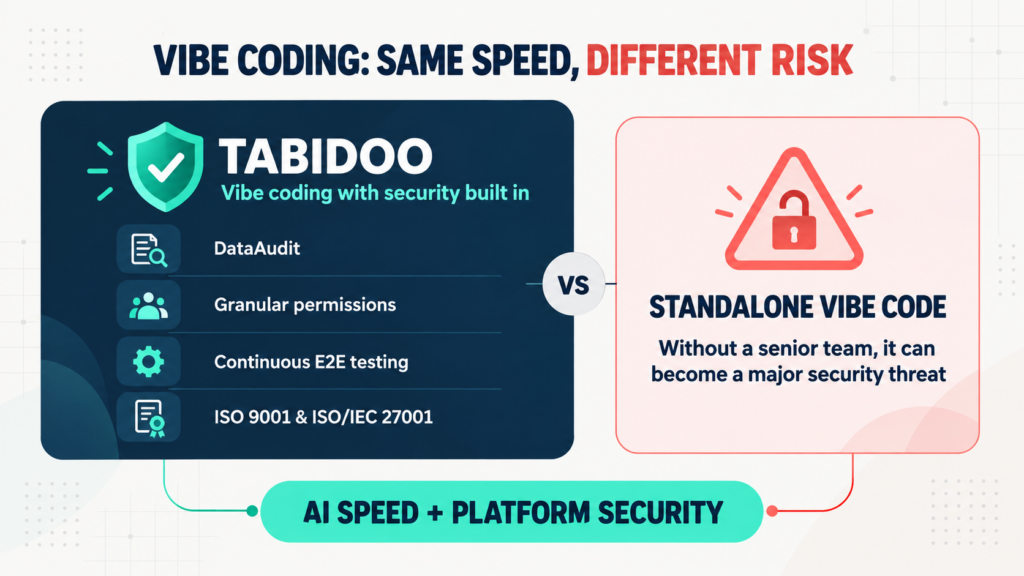
Vibe coding delivers speed, but not automatic security. Tabidoo combines AI with DataAudit, granular permissions, continuous E2E testing and certified processes.
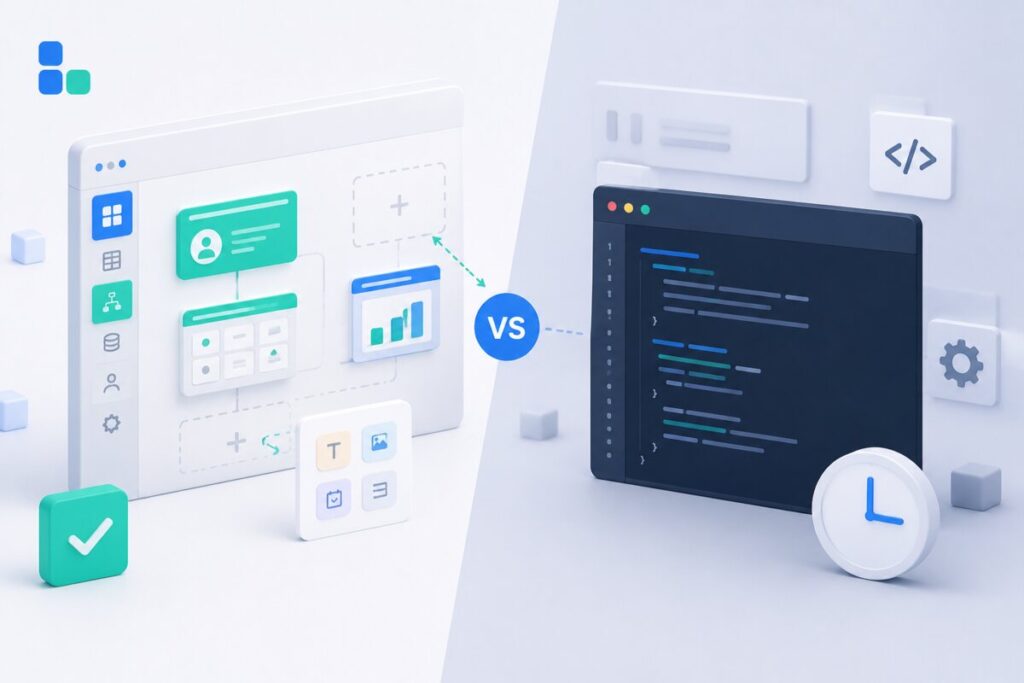
Learn when to build an internal app in Tabidoo – with no per-user fees, flexible workflows, role-based access, audit history, API and custom logic.
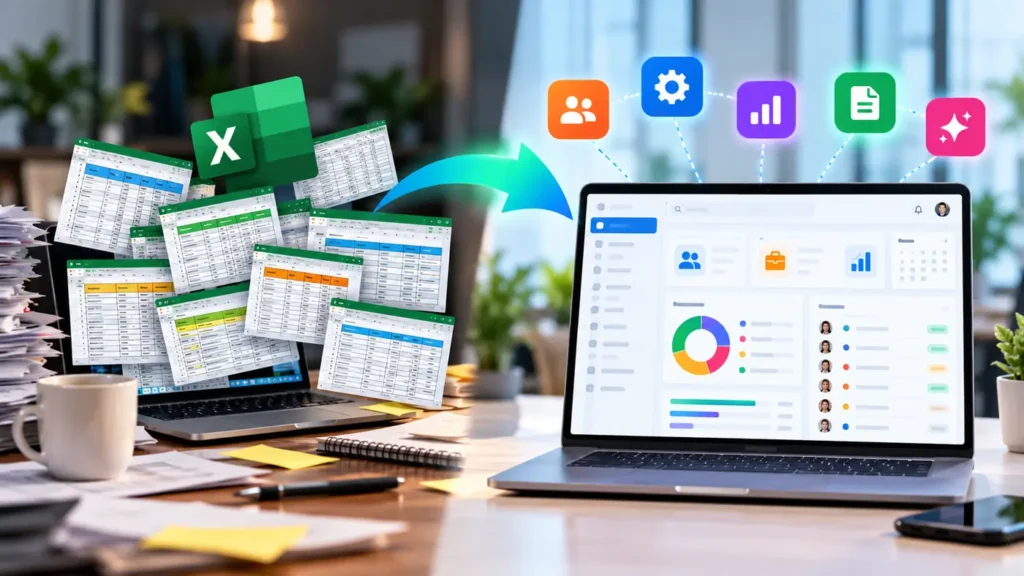
Tabidoo is one of the best alternatives to Excel for managing business processes if you want to connect data, automate workflows, and build custom applications without coding. This Czech no-code/low-code platform allows businesses to replace disconnected spreadsheets with an integrated system for managing customers, orders, projects, and other operations. With Tabidoo AI, you can even start with an Excel spreadsheet you already use.