
Workflow automation
Published May 31, 2026
When companies start looking for a way to replace spreadsheets, centralize business data, or build their own CRM, they often come across two tools: Tabidoo and Airtable. Both are modern low-code platforms that allow users to create custom applications without programming, and both promise better organization of data and business processes. However, there are several key differences between them.
Author Tabidoo
8 minutes to read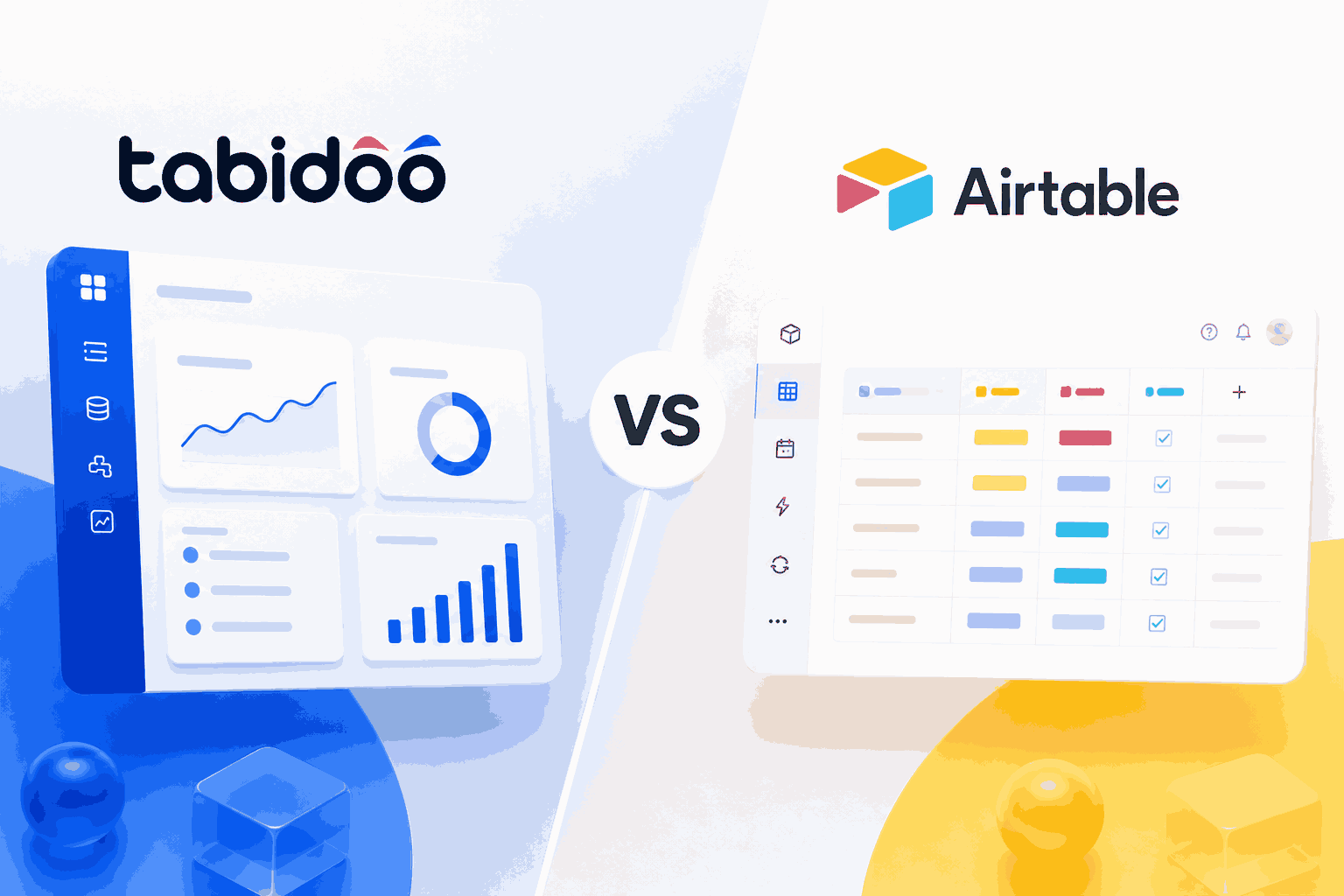
When companies start looking for a way to replace spreadsheets, centralize business data, or build their own CRM, they often come across two tools: Tabidoo and Airtable. Both are modern low-code platforms that allow users to create custom applications without programming, and both promise better organization of data and business processes. However, there are several key differences between them.
While both platforms enable businesses to manage data and create custom solutions without coding, their primary focus differs significantly. Airtable gained popularity as a modern database tool with an intuitive user experience, while Tabidoo was built specifically for business process digitalization and the creation of applications that adapt to the way a company operates. Let’s take a closer look at how the two platforms compare.
Airtable was founded in 2012 in the United States as a combination of a spreadsheet and a relational database. Its goal was to provide users with a more flexible and user-friendly alternative to Excel while making it easier to organize and connect data.
Over time, Airtable has become one of the world’s most recognized no-code platforms. Today, it is used by startups, marketing teams, agencies, and larger organizations to manage projects, campaigns, content, and internal databases.
Its biggest strengths are simplicity, ease of use, and a large ecosystem of templates and integrations.
Tabidoo was developed in the Czech Republic with a different philosophy. From the very beginning, it was designed as a platform for business process digitalization and the creation of custom business applications without programming.
Companies use Tabidoo to build solutions such as:
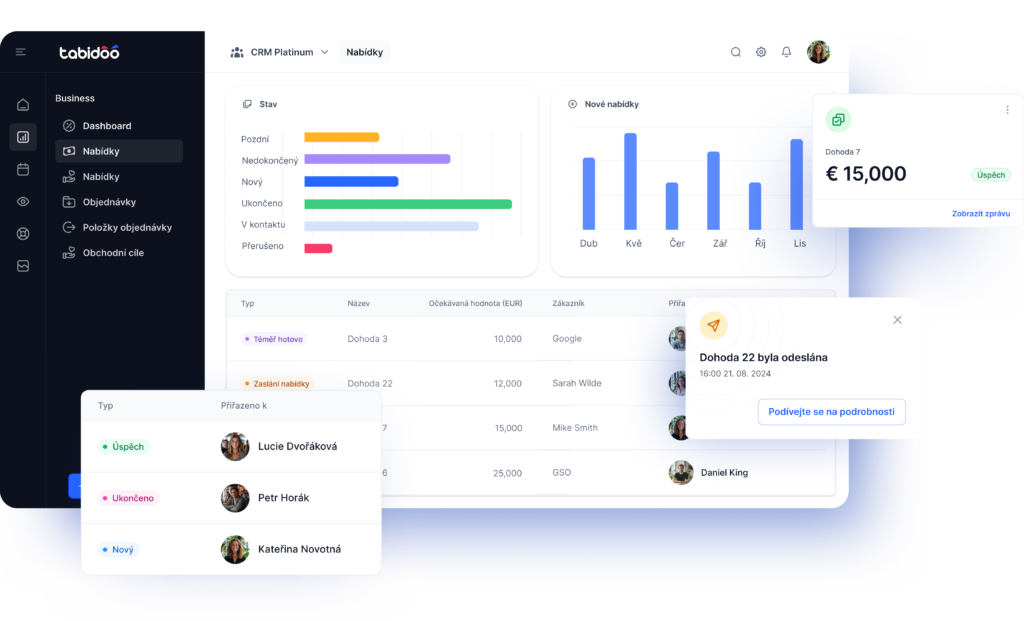
Instead of offering a generic database, Tabidoo provides an environment where businesses can create applications tailored to their specific needs and continuously adapt them as the company grows without relying on developers.
The biggest difference between the two platforms is not their feature set, but their philosophy.
Airtable starts with data. Users first create a database and then build processes, automations, and applications around it. Tabidoo starts with processes. Companies first define how their business works and then create an application that supports those workflows.
At first glance, this may seem like a subtle distinction. In practice, however, it has a major impact on how easily the system can evolve alongside a growing business.
When it comes to pure data management, both platforms are highly capable.
For managing customers, projects, orders, or employees, both solutions are more than sufficient. The differences become more apparent when businesses need to build more complex processes on top of their data.
This is where Tabidoo begins to stand out.
Historically, Airtable was developed as a database platform, with applications and workflows added over time. Tabidoo, on the other hand, was built from the ground up as a platform for creating business applications.
If a company needs a custom CRM, recruitment system, customer service application, vehicle management solution, document approval process, or manufacturing management system, Tabidoo offers a higher level of customization without requiring multiple external tools.
Instead of adapting to a predefined template, companies can create a system that reflects the way they actually operate.
Automation is now a standard feature in most modern platforms. The difference lies in how far those automations can go.
Tabidoo extends these capabilities by supporting more advanced approval processes, multi-level permissions, cross-department workflows, and company-wide automation scenarios.
For this reason, many businesses use Tabidoo as the foundation for digitalizing internal operations and gradually transforming it into a central system for managing their organization.
If there is one area where Airtable traditionally excels, it is user experience. Its interface is modern, intuitive, and easy to learn.
Tabidoo offers greater flexibility but also more configuration options. As a result, designing an application may initially require more consideration of business processes and requirements. However, Tabidoo’s AI-powered features significantly simplify and accelerate this process.
For simple database projects, Airtable may provide a faster start. For long-term business use, however, flexibility often becomes more important than initial simplicity.
Both platforms support:
The key difference lies in their intended use.
Airtable is often used as one component within a larger technology stack, primarily serving as a data layer. Tabidoo can frequently replace multiple tools and provide a centralized environment for managing business processes. As a result, companies often need fewer integrations and spend less time maintaining them.
Artificial intelligence is becoming an essential part of modern low-code platforms, and both Airtable and Tabidoo are actively incorporating AI into their products.
Today, Tabidoo uses AI to assist with form creation, application logic design, and the automation of repetitive tasks. This enables users to build and modify applications faster, with fewer technical skills and lower implementation costs.
One of the most significant developments is the ability to create business applications using natural language. Tabidoo is becoming one of the first platforms of its kind to allow users to design applications simply by describing what they need.
Instead of manually configuring databases, forms, and workflows, users can generate the foundation of an application within minutes and then fine-tune it according to their business requirements.
For companies, this means faster digital transformation, shorter implementation times, reduced dependence on IT teams, and the ability to respond to change almost instantly. This is where the true potential of AI in Tabidoo becomes evident – not only in managing data, but also in accelerating the creation and evolution of business applications themselves.
Airtable primarily uses a per-user licensing model. As the number of employees grows, costs increase accordingly.
For smaller teams, this is rarely a concern. However, once sales, marketing, HR, customer service, and operations all start using the platform, costs can grow rapidly.
Tabidoo approaches scalability differently. Instead of charging per user, licensing is independent of the number of users accessing the platform.
This often allows companies to involve more employees without experiencing the same proportional increase in costs. For organizations planning long-term growth, this difference can be highly significant.
Airtable benefits from more than a decade of global community growth. Users have access to thousands of tutorials, templates, videos, and discussion forums.
Tabidoo is a smaller platform, but it offers local support, communication in Czech, and a deep understanding of the needs of Czech and European businesses. For many organizations, direct access to the vendor and personalized support can be more valuable than a large online community.
Airtable is particularly suitable for:
It is ideal when speed of deployment, simplicity, and data management are the top priorities.
Tabidoo is especially suitable for companies that want to:
The more processes a company needs to manage, the more valuable Tabidoo typically becomes.
Airtable is undoubtedly one of the best database platforms on the market. It offers an excellent user experience, a strong community, and a fast learning curve.
However, once companies begin dealing with real business processes, the requirements often change.
Managing data alone is no longer enough. Businesses need to coordinate sales, approve documents, plan resources, streamline recruitment, automate service operations, and connect multiple departments within a single system.
This is where the distinction between a database platform and a process platform becomes clear.
Tabidoo was not built as a database with additional features layered on top. From the beginning, it was designed as a platform for creating business applications and digitalizing business processes. As a result, it can replace not only spreadsheets but often multiple standalone tools as well.
Companies gain a centralized environment that adapts to the way they work, rather than forcing them to adapt their processes to software limitations.
If your primary goal is managing data, Airtable is an excellent choice. If you are looking for a platform that can grow alongside your business, support digital transformation across departments, and enable you to build systems tailored to your exact needs, Tabidoo is often the stronger option.
Workflow automation
Reports
Multilingual
Quick setup, zero risk, full control.
No trial limits
No user fees
No credit card required
Quickbase is a mature enterprise platform for dynamic work. Tabidoo offers a focused process foundation, full AI support, an MCP server, ISO certification and unlimited users in a simpler commercial model. Where does each platform have the real advantage?
Bubble and Tabidoo both let teams build applications without traditional development, but they start from different places. Bubble gives product builders a flexible canvas. Tabidoo turns business data and processes into a governed system with full AI support and an MCP server. Which approach fits your goal?
Zoho Creator offers a broad low-code ecosystem, native mobile applications, AI and a large integration catalogue. Tabidoo combines full AI support, MCP, ISO certification, PWA, direct integrations and unlimited users in a more focused platform. Which approach fits your organisation?
Base44 and Tabidoo both put AI at the centre of application creation. Base44 excels at speed and visual impact. Tabidoo combines full AI support with governed business data, ISO certification, PWA and an MCP server for agents working with live applications. Which approach is stronger?