
Workflow automation
Published May 31, 2026
Both Raynet and Tabidoo help businesses gain better visibility into customers, sales opportunities, and day-to-day operations. However, they take two very different approaches. While Raynet is a dedicated CRM system ready to use out of the box, Tabidoo allows you to build your own CRM and connect it with other business processes and applications. Which solution is the better fit for your company?
Author Tabidoo
6 minutes to read
Both Raynet and Tabidoo help businesses gain better visibility into customers, sales opportunities, and day-to-day operations. However, they take two very different approaches. While Raynet is a dedicated CRM system ready to use out of the box, Tabidoo allows you to build your own CRM and connect it with other business processes and applications. Which solution is the better fit for your company?
Raynet is one of the most well-known CRM systems on the Czech market. It is designed primarily for sales teams that want better control over contacts, sales opportunities, activities, and customer communication.
Its main advantage is quick deployment and ease of use. Companies get a ready-to-use CRM solution with a proven structure and can start using it almost immediately.
If your primary goal is to implement a CRM system, Raynet is a strong contender.
Tabidoo is a Czech low-code platform that enables companies to create and customize business applications without programming.
The platform includes a ready-made CRM solution that businesses can use similarly to a traditional CRM system. Unlike conventional CRM tools, however, it is not limited to sales processes alone.
The result is not a collection of disconnected applications, but one integrated environment.
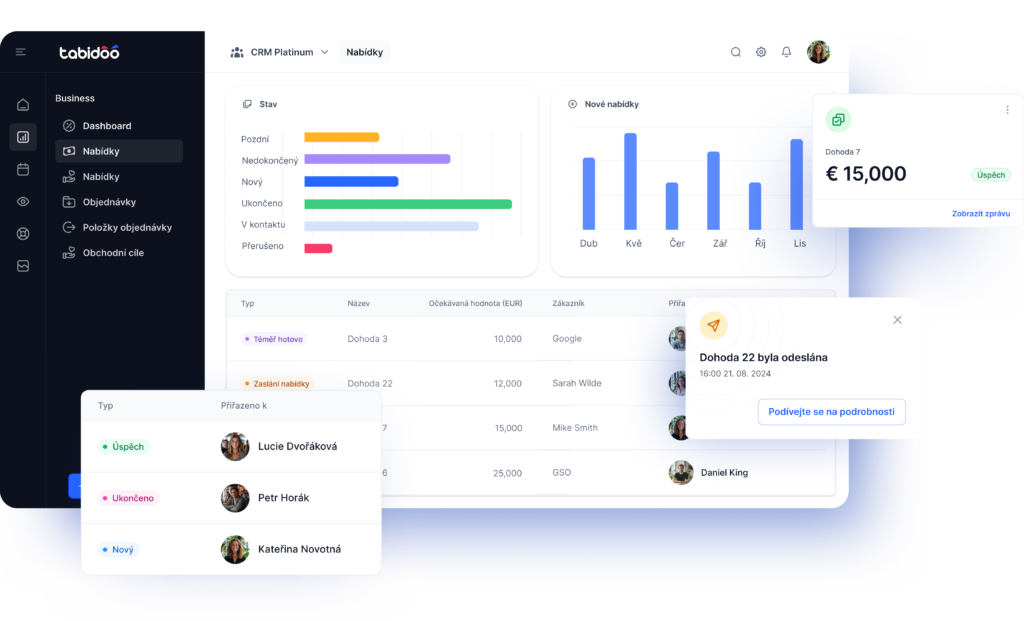
Both platforms help companies manage customers, opportunities, and communication. The key difference lies in how much the system can be customized.
Raynet provides a CRM with a predefined structure and proven best practices that fit the needs of most sales teams. This makes implementation fast and intuitive.
Tabidoo also offers a ready-made CRM solution, but allows businesses to further develop and adapt it according to their needs. Companies do not have to start from scratch, yet they are not restricted by a fixed system structure.
If your company follows a standard sales process, Raynet will likely meet all your requirements. If your business has specific needs or expects its processes to evolve over time, Tabidoo provides greater flexibility.
Sales teams will find all the features they expect from a modern CRM in both systems, including:
Raynet stands out for the simplicity and clarity of its sales workflow.
Tabidoo adds the ability to customize each stage of the sales cycle according to specific business requirements. Companies can modify forms, tracked information, sales stages, and connections to other business processes – without needing a developer.
This is particularly valuable for organizations that do not operate according to a standard model.
Every software solution involves some level of compromise. The real question is: who adapts to whom? With Raynet, companies adopt a proven workflow designed for a wide range of sales teams. With Tabidoo, companies can adapt the system to their own way of working.
As a result, the system can reflect how the company actually operates, rather than forcing the company to adapt to software limitations.
Modern CRM systems are no longer just contact databases. Automation plays an increasingly important role. Raynet helps automate sales activities and simplifies the daily work of sales representatives. Tabidoo goes beyond sales and enables automation across connected business processes.
For example, after a deal is closed, Tabidoo can automatically:
This creates connected workflows across the entire organization instead of isolated processes.
Artificial intelligence is transforming the way companies interact with software.
Tabidoo uses AI to assist with form creation, application logic configuration, and simplifying system setup. Development is also moving toward enabling users to create business applications using natural language.
Instead of manually configuring databases, forms, and workflows, users will simply describe what they need, and the platform will generate the appropriate application structure – whether they need a CRM, a custom task management system, an ATS, or another business solution.
This gives companies greater independence and a significantly faster path from idea to implementation.
When selecting a CRM, it is natural to compare subscription costs. However, over the long term, it is often more important to consider how many systems a company needs and how costs scale as the organization grows.
Raynet offers several pricing plans based on the number of users. Costs range from lower monthly fees per user to higher-tier plans with advanced functionality. As sales teams grow, overall licensing costs increase accordingly.
Tabidoo follows a different approach. Pricing is not based on a traditional per-user model, but on the platform license and the scope of the solution being used. This allows companies to involve any number of employees without costs increasing linearly with every additional user.
The difference becomes particularly significant when businesses need to manage recruitment, customer support, approvals, projects, or other internal processes alongside CRM.
While specialized tools often require additional licenses and integrations, Tabidoo allows organizations to expand their existing environment with new applications and workflows.
Raynet was designed as a CRM system, and it excels in that role.
However, when businesses need to connect sales with other operational areas, additional tools and integrations are often required.
Tabidoo offers significantly broader customization options than traditional CRM systems. To fully leverage its potential, companies should have at least a basic vision of how they want their business processes to connect and evolve. The reward is a platform that can continuously adapt without requiring a switch to new software every time the business changes.
Raynet is one of the highest-quality CRM systems available on the Czech market and provides many sales teams with a fast path to better organization and visibility. Over time, however, many businesses realize that sales is not the only area they need to manage effectively. Projects, customer service, support, approvals, and recruitment become increasingly important.
At that point, the decision is no longer just about choosing a CRM. It becomes a question of choosing a platform that can grow alongside the company.
Tabidoo offers the advantage of a ready-made CRM solution while also enabling businesses to gradually build additional applications and processes without migrating to new systems.
As a result, it can become not only a sales tool, but the foundation of a company’s entire digital ecosystem.
Workflow automation
Reports
Multilingual
Quick setup, zero risk, full control.
No trial limits
No user fees
No credit card required
Quickbase is a mature enterprise platform for dynamic work. Tabidoo offers a focused process foundation, full AI support, an MCP server, ISO certification and unlimited users in a simpler commercial model. Where does each platform have the real advantage?
Bubble and Tabidoo both let teams build applications without traditional development, but they start from different places. Bubble gives product builders a flexible canvas. Tabidoo turns business data and processes into a governed system with full AI support and an MCP server. Which approach fits your goal?
Zoho Creator offers a broad low-code ecosystem, native mobile applications, AI and a large integration catalogue. Tabidoo combines full AI support, MCP, ISO certification, PWA, direct integrations and unlimited users in a more focused platform. Which approach fits your organisation?
Base44 and Tabidoo both put AI at the centre of application creation. Base44 excels at speed and visual impact. Tabidoo combines full AI support with governed business data, ISO certification, PWA and an MCP server for agents working with live applications. Which approach is stronger?