
Workflow automation
Published October 14, 2026
Tabidoo is a better choice for companies that want to tailor their software to their processes, connect business data, and automate everyday operations. Trello primarily focuses on visual task and project management, while Tabidoo allows businesses to build custom applications that support the needs of different departments.
Author Tabidoo
12 minutes to read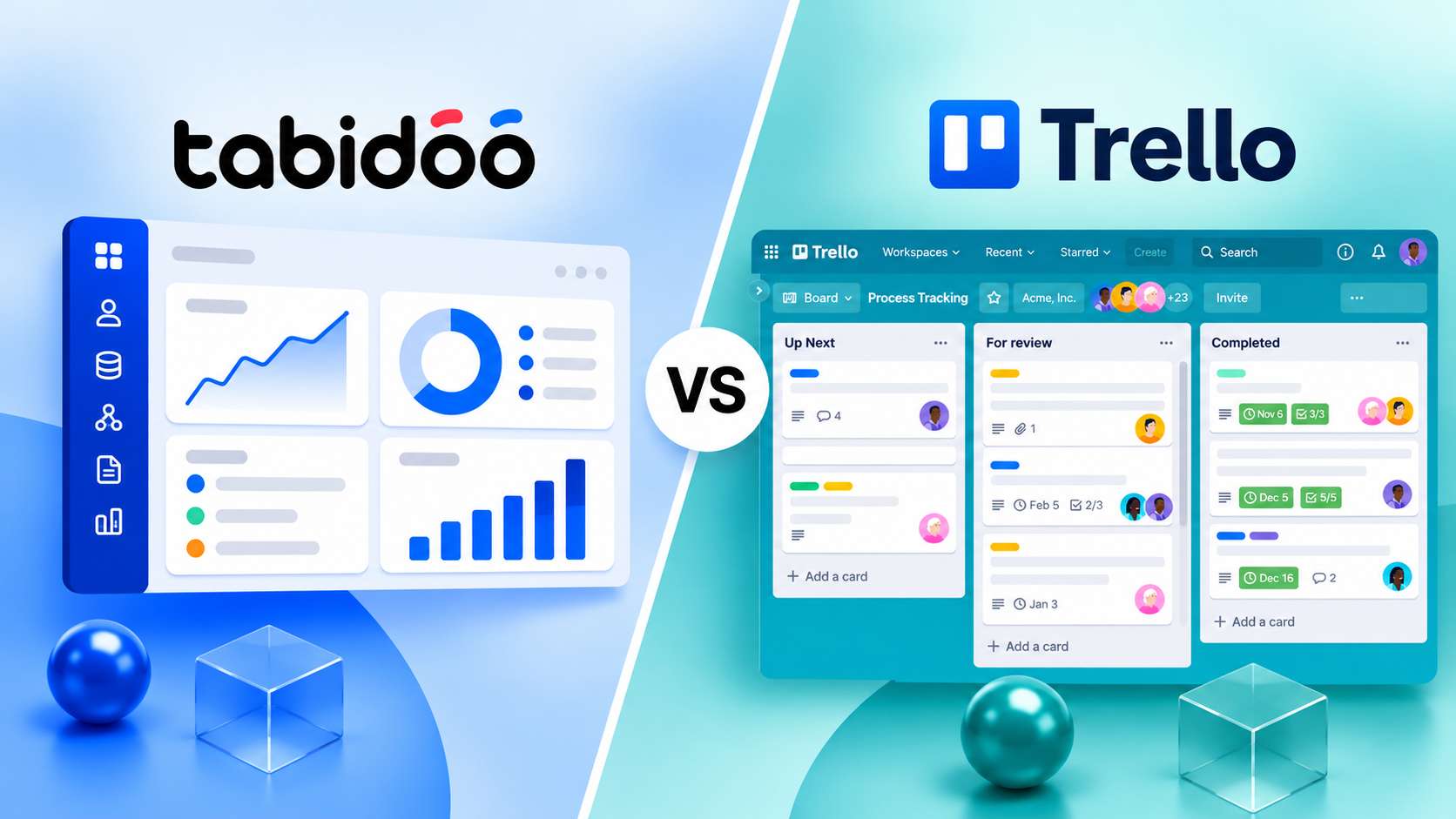
Tabidoo is a better choice for companies that want to tailor their software to their processes, connect business data, and automate everyday operations. Trello primarily focuses on visual task and project management, while Tabidoo allows businesses to build custom applications that support the needs of different departments.
At the beginning of a business, a shared spreadsheet, a simple task list, or a project board is often enough. However, as the number of customers, employees, and internal processes grows, keeping track of individual tasks is no longer sufficient. Companies also need visibility into related data, responsibilities, and the entire workflow.
This is where the difference between a project management tool and a platform for building business applications becomes clear.
Trello helps teams organize tasks using boards, lists, and cards. Tabidoo takes a broader approach: it allows you to design applications around your company’s needs, connect different business areas, and configure workflows without developing an entire system from scratch.
If you’re looking for a solution that can grow alongside your business rather than limit you to a single way of organizing work, Tabidoo is worth a closer look.
Tabidoo is a no-code/low-code platform for building business applications and digitizing processes. Its main advantage is the ability to tailor the structure and functionality of applications to the way your company actually operates.
Instead of adapting your internal procedures to a predefined tool, you can create a solution that fits your requirements. Need a CRM, order management system, project management application, or supplier database? With Tabidoo, you can design individual applications around your needs and manage them within one platform.
The result can be an environment where related information stays connected and employees don’t have to constantly switch between disconnected records and tools.
Every company operates differently. A manufacturing business needs to track orders and materials, a marketing agency manages clients and campaigns, and a service company handles customer requests and delivery schedules.
A standard project management tool may not be the best fit for every situation.
Tabidoo allows you to create applications that reflect your specific workflows. You decide which information to track, how records relate to one another, and what information different employees need to access.
The advantage is that you don’t have to replace your entire system whenever your business changes. You can modify and expand your applications as new requirements emerge.
Trello, on the other hand, is built primarily around boards and cards. These can be customized and extended using available features, but if you need to build a more complex data structure or manage a specialized business function, Tabidoo provides a more suitable foundation.
Customer information rarely becomes irrelevant once a deal is closed. The next steps may include order processing, project delivery, invoicing, or ongoing customer support. When these details are scattered across spreadsheets and separate tools, managing them can become unnecessarily complicated.
Tabidoo allows you to create connected data structures and work with information across your custom applications. For example, you can link an order to a customer, a project to a specific contract, or a service request to a registered piece of equipment.
This makes it easier to maintain an overview of the relationships that matter to your business.
Trello can store information in cards, attach files, and support team communication. However, its primary purpose remains task and project organization. Tabidoo is a better fit for companies that want to manage not only tasks but also the structured business data behind their operations.
Automation saves time, reduces manual work, and helps companies manage routine activities more efficiently. Its real value, however, becomes apparent when it reflects the way a business operates.
Tabidoo allows you to configure automations around your custom applications and data. Depending on the setup, these can respond to record changes, send notifications, transfer information, or support approval workflows.
Consider a company that processes customer orders. Creating a new order could trigger the next step in the workflow. A change in status could notify the responsible employee, while meeting predefined conditions could pass information to the next stage of the process.
The important point is that these workflows can operate around the data stored in the relevant applications.
Trello also offers automation for repetitive activities, such as moving cards, adjusting due dates, or triggering actions based on predefined rules. These features are useful for organizing projects. However, if you need to automate broader business processes involving different types of records and business functions, Tabidoo is worth considering.
Both tools help teams organize work, but they differ in the range of business needs they can address.
| Feature or Area | Tabidoo | Trello |
|---|---|---|
| Main focus | Custom business applications, data, and processes | Task organization and project management |
| Custom applications | Yes, applications can be built around business needs | Primarily boards, lists, and cards |
| Data management | Custom tables and connected records | Information organized mainly through cards |
| Business process customization | Extensive configuration options for custom applications | Customization of project boards and workflows |
| Automation | Process automation and data-driven workflows | Automation of tasks and actions within Trello |
| Access management | Roles and permissions based on application configuration | Permissions and member management based on workspace settings |
| Reports and dashboards | Dashboards and data views configured for applications | Available views and reporting features depending on the plan |
| AI features | AI assistance for creating and modifying applications | AI features supporting work with boards and content |
| Typical use cases | Business operations, internal systems, and process digitization | Team collaboration and project management |
| Pricing model | Not based on the number of users | Paid plans are priced according to the number of workspace members |
Tabidoo stands out when a company needs software that adapts to its own way of working. Trello remains a good choice for straightforward project planning, but Tabidoo offers broader options for managing business data and building custom applications.
The availability of specific features depends on the current plans and configuration of each platform.
Artificial intelligence can save businesses time not only when processing information but also when creating software itself.
Tabidoo uses AI to support the creation and modification of business applications. Users can describe what they need to manage and get help designing an appropriate structure. The application can then be refined, expanded with additional functionality, and adapted to specific requirements.
This can make the journey from an initial idea to a practical business tool much easier.
For example, if you need to manage customers, their orders, and related tasks, you can start by describing the solution you want to create. You can then adjust the resulting application to reflect the information you need to track and the way your team works with it.
Trello offers AI features primarily designed to support work within its own environment. These can be useful for teams looking to improve project planning and work more efficiently with board content.
The difference is that Tabidoo also allows you to use AI when creating custom business applications, rather than focusing solely on tasks and project boards.
Specific capabilities continue to evolve, so it’s worth checking the latest product documentation before implementation.
When choosing business software, it’s worth looking at how the cost changes as your team grows.
Tabidoo uses a pricing model that is not based on the number of users. Adding another colleague therefore does not automatically increase the price simply because they need access to your applications. Each plan still has its own limits, so you should consider the required features and expected usage when choosing the right option.
This approach can be particularly attractive to companies that want to use custom applications across multiple departments and give more employees access to the same system.
Trello offers a free plan alongside paid subscriptions, with pricing based on the number of workspace members. Which option offers better value depends on your team size and the features you need.
It’s also important to consider what you’re paying for. If you use Trello only for straightforward task planning, its pricing may be perfectly reasonable. However, if you need to manage several business functions and build custom applications, you should evaluate the cost in the context of the complete solution.
As companies grow, the same problem often emerges: each team uses a different tool, and information becomes scattered across multiple systems. One employee maintains records in a spreadsheet, another manages tasks in a project management application, and other important details remain buried in email conversations.
The result can be more complicated handovers, duplicated data entry, and limited visibility into the company’s overall operations.
Tabidoo offers a different approach. Instead of searching for a separate tool every time a new need arises, you can build applications for different business functions and expand them as your requirements change.
Key benefits include:
Tabidoo doesn’t have to be just a tool for one specific task. It can become the foundation for digitizing different areas of your business operations.
To make a fair comparison, it’s also important to recognize situations where a simpler tool may be the more practical choice.
If your requirements are limited to task planning, Trello may meet your needs without unnecessary complexity. However, if you also need to manage records, connect data, and create custom workflows, Tabidoo offers more room to adapt the system to your business.
It depends on your specific requirements. Tabidoo is better suited to companies that need custom applications, connected data, and business process automation. Trello may be more practical for straightforward task planning and project management. If you’re looking for a solution that supports broader business digitization, Tabidoo offers more flexibility.
In many scenarios, yes. You can build a project management application in Tabidoo and adapt it to the way your company works. In addition to tasks, you can manage related data and other business functions. Whether it can fully replace your current Trello setup depends on the specific features you use today.
Yes. Tabidoo allows you to create custom business applications, including CRMs, order management systems, and other internal tools. Their structure and functionality can be tailored to your company’s requirements.
Tabidoo is a no-code/low-code platform, so you don’t need to program every component from scratch. Many applications can be built using the platform’s available tools and configuration options. More complex requirements may involve more advanced setup.
Trello primarily focuses on organizing work through boards, lists, and cards. Tabidoo allows you to build custom business applications and tailor data structures, automations, and workflows. The key difference lies in the broader range of business needs Tabidoo can support.
Trello is a useful tool for organizing tasks, planning projects, and supporting team collaboration. If you mainly need a visual board that helps employees keep track of their work, it can be a suitable choice.
Tabidoo, however, offers broader capabilities for companies that want to digitize their processes, connect business data, and build applications around their own requirements. Instead of adapting your business to the limitations of a single type of tool, you can design a solution that reflects the way your company operates.
The ability to combine custom applications, data management, and automation makes Tabidoo an attractive option for companies that want greater control over their processes and the flexibility to expand their systems over time.
If all you need is a task management tool, Trello may be enough. But if you want to build an environment that supports the needs of your entire business, start with Tabidoo.
Workflow automation

Reports
Multilingual
Quick setup, zero risk, full control.
No trial limits
No user fees
No credit card required
Salesforce is a powerful CRM platform for managing sales and customer relationships. Tabidoo offers a more flexible alternative for companies that want to build custom applications, tailor workflows to their needs, and manage business data without per-user fees. The right choice depends on your company’s requirements, the features you need, and your budget.
Tabidoo is a better choice than Zapier for companies that want to do more than automate workflows and need custom business applications to manage their processes in one place. Zapier primarily focuses on automating tasks and connecting existing apps. Tabidoo allows you to build tailored applications, manage business data, and automate processes within a single platform.
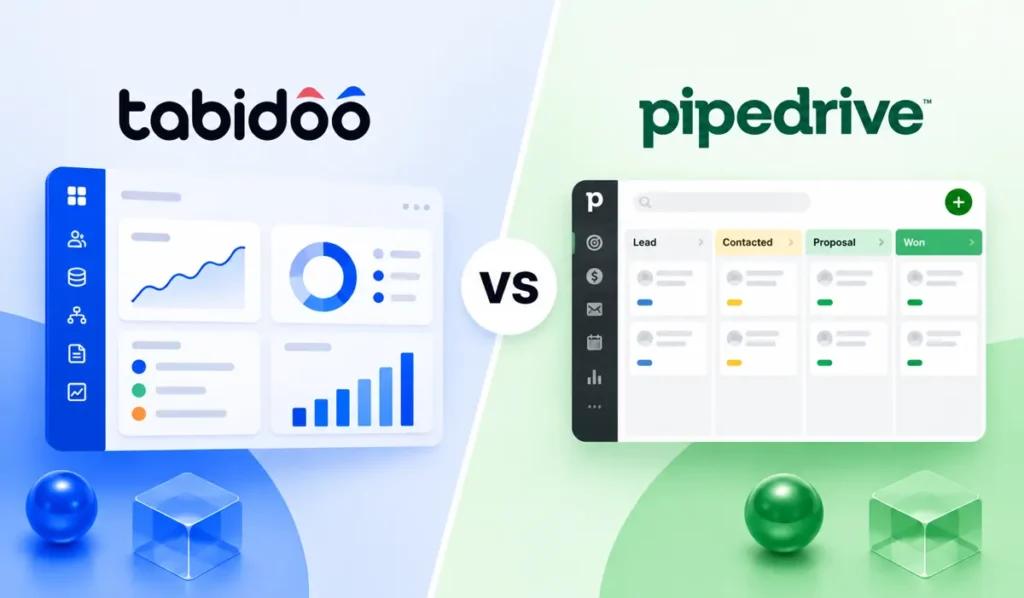
Tabidoo is a better choice than Pipedrive for companies that want to connect CRM with order management, project delivery, and other business processes. Pipedrive is a specialized CRM focused on sales pipelines, customer communication, and closing deals. Tabidoo lets you build your own CRM and extend it with connected business applications on a single platform.

Tabidoo is a better choice than Freelo for companies that need to manage not only projects and tasks, but also customers, orders, approvals, and other business processes. Freelo is a Czech project management tool focused on team collaboration, task management, and time tracking. Tabidoo is a no-code/low-code platform that lets you build connected business applications tailored to the way your company operates.