
Workflow automation
Published September 29, 2026
Tabidoo is a better choice than Pipedrive for companies that want to connect CRM with order management, project delivery, and other business processes. Pipedrive is a specialized CRM focused on sales pipelines, customer communication, and closing deals. Tabidoo lets you build your own CRM and extend it with connected business applications on a single platform.
Author Tabidoo
9 minutes to read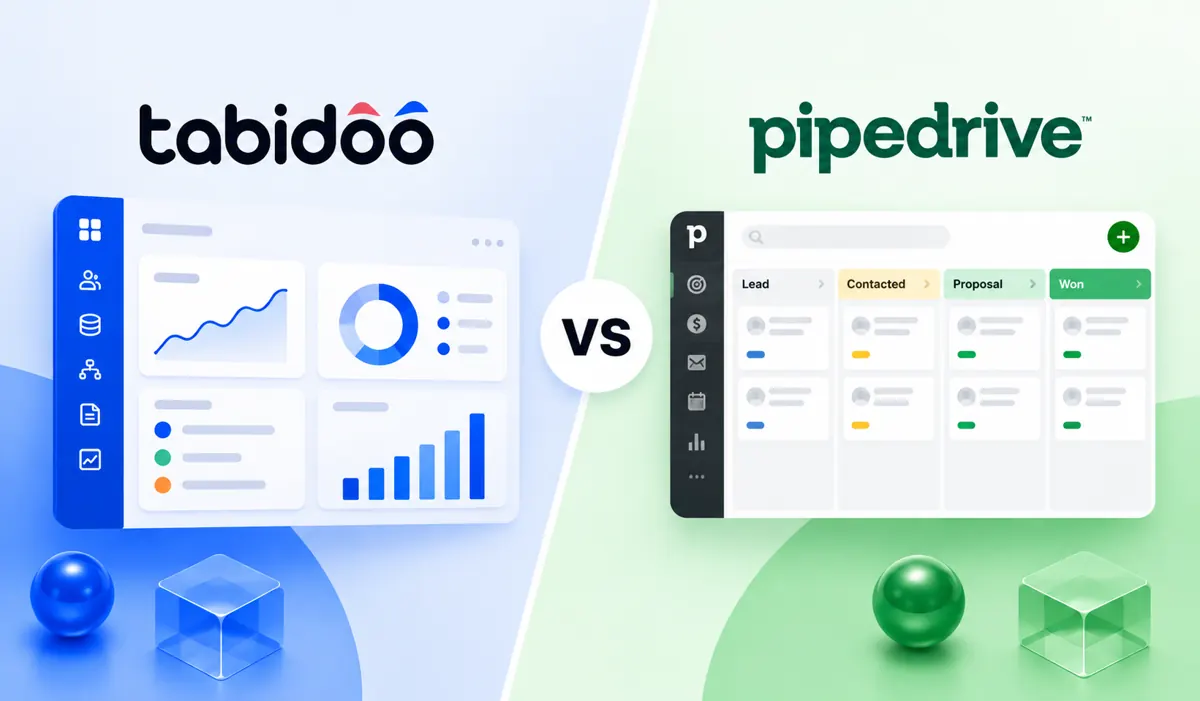
Another major difference is pricing: Pipedrive charges per user on its paid plans, while Tabidoo has no per-user fees.
A sales opportunity moves to Won in your CRM. The salesperson has done their job. But for the rest of the company, the work is often just beginning. Someone needs to prepare the contract, schedule delivery, order materials, assign team members, or arrange ongoing service. And this is where the difference between a specialized CRM and a business application platform becomes clear.
Pipedrive helps companies manage their sales process. Tabidoo lets them build a system where sales connect naturally with everything that comes next.
That doesn’t mean Pipedrive lacks project management or automation features. It offers both. However, its core structure is built around sales, while Tabidoo allows companies to create different types of applications using connected data.
| Feature | Tabidoo | Pipedrive |
|---|---|---|
| Primary focus | Building custom business applications | CRM and sales pipeline management |
| Contact and customer management | Yes, through a custom CRM | Yes, ready-to-use CRM |
| Sales pipeline | Customizable to your business needs | Ready-made, visual, and customizable |
| Order management after closing a deal | Custom connected application | Projects and related features |
| Inventory, assets, service, or HR | Custom applications on one platform | Outside the core CRM focus |
| Automation | Custom workflows across business processes | Sales and communication automation |
| AI | Building and modifying applications with natural language | AI for sales, reporting, and communication |
| Integrations | API, Make, Zapier | Extensive integration marketplace |
| Per-user pricing | No per-user fees | Paid plans priced per seat |
The biggest difference isn’t whether both platforms can store customer information. It’s what you can do with that information next.
For a useful comparison, it’s important to acknowledge what Pipedrive does particularly well. Pipedrive is designed specifically for sales teams. It offers a visual sales pipeline, activity management, meeting scheduling, email tools, and sales-focused reporting.
Higher-tier plans include more advanced automation, lead generation and qualification tools, contract management features, and additional communication capabilities.
If your main priority is to quickly implement a ready-made CRM for your sales team without designing your own application, Pipedrive may be the more practical choice. But not every company needs to improve sales alone. Many need to eliminate the gaps between sales and operations.
In Pipedrive, customer information is primarily organized around the sales process. In Tabidoo, customer records can be connected to other areas of your business.
Imagine a service company. For each customer, it needs to track contacts, order history, serviced equipment, assigned technicians, documentation, and upcoming inspections. Tabidoo allows these records to be organized into connected applications. Salespeople can access sales history. Service technicians have the information they need to complete their work. Management gets visibility into the entire process.
The same information can support multiple departments without each team maintaining its own separate system.
Some companies sell products. Others deliver long-term projects, rent equipment, or provide recurring services. A standard CRM doesn’t always reflect how a particular company operates. Tabidoo allows you to design custom data fields, relationships between records, forms, and business rules.
For example, you can connect a sales opportunity to a specific piece of equipment, business location, contract, or service schedule.
It’s not just about adding more fields to a CRM. You can customize the underlying structure of the application to match the way your business works.
Both platforms use artificial intelligence, but for different purposes. Pipedrive uses AI to support areas such as reporting, sales communication, and working with customer information. With Tabidoo AI, you can describe the application you want to create: „I need a CRM for a sales company. I want to track customers, sales opportunities, quotes, and orders. Once a quote is approved, the order should be handed over to the delivery team.”
AI helps you create the data structure, connected tables, and initial application setup. You can then refine it to meet your actual requirements. While AI in a CRM helps salespeople do their jobs, Tabidoo AI helps companies build the tools they work with.
Closing a deal shouldn’t mean manually copying information into other tools. In Tabidoo, you can configure connections between sales and operational records.
For example, approving a quote can create an order, assign a responsible employee, update its status, and trigger a follow-up workflow.
Pipedrive also supports automation and project management after a deal is closed. However, if you need more extensive custom operational logic, building it directly in Tabidoo may be more effective.
CRMs are often used primarily by salespeople. But a connected business system also needs to serve delivery teams, service technicians, administrative staff, and management.
And that’s where pricing becomes important. Tabidoo doesn’t charge per user. You can invite more colleagues to work with your applications without automatically increasing the subscription cost for every additional account. Pipedrive’s paid plans, on the other hand, are priced per seat.
If multiple departments need access to customer and operational data, Tabidoo’s pricing model can be a significant advantage.
When choosing a CRM, companies often focus on the cost per user. But a more important question might be how many people will need access to the system in one or two years.
| Plan | Monthly price with annual billing | Users |
|---|---|---|
| Free | CZK 0 | No per-user fees |
| Basic | CZK 1,500 | No per-user fees |
| Standard | CZK 3,000 | No per-user fees |
| Pro | CZK 6,000 | No per-user fees |
| Enterprise | Custom pricing | No per-user fees |
Prices exclude VAT. Plans differ in application capacity, number of records, storage, and automation limits.
For example, the Basic plan includes 10 applications, 25,000 records per application, and 1,000 workflow executions per day.
| Plan | Price per user/month with annual billing |
|---|---|
| Lite | USD 14 |
| Growth | USD 39 |
| Premium | USD 59 |
| Ultimate | USD 79 |
Pipedrive offers a 14-day free trial. Depending on the selected plan, some additional features may require paid add-ons.
Imagine a company that needs to give 15 employees access to customer and operational data.
| Solution | Monthly cost | Annual cost |
|---|---|---|
| Tabidoo Basic | CZK 1,500 | CZK 18,000 |
| Pipedrive Lite, 15 users | USD 210 | USD 2,520 |
| Pipedrive Growth, 15 users | USD 585 | USD 7,020 |
This is an illustrative comparison of pricing models, not a like-for-like comparison of features. Prices are shown in different currencies and exclude potential additional costs.
With Tabidoo, costs may increase if you exceed your plan’s capacity limits. With Pipedrive, license costs increase as you add more paid seats.
From a financial perspective, it’s worth comparing not only the cost of your CRM today but also how many people and processes you’ll want to bring into the system over time.
Pipedrive is a good choice for companies with a clearly defined sales process that want to quickly implement a ready-made CRM with specialized sales features.
Tabidoo makes more sense when:
Keep in mind that building a custom CRM requires some initial process design and configuration. Tabidoo AI can make this considerably easier, but a good setup still starts with understanding how your company operates.
Yes. With Tabidoo, you can build your own CRM for managing customers, sales opportunities, and orders. Unlike a specialized CRM such as Pipedrive, you can also extend it with applications for other business operations.
It can be, especially if you need more users. Tabidoo doesn’t charge per user, while Pipedrive’s paid plans use per-seat pricing. However, total costs also depend on the required features, capacity, and implementation.
Yes. In Tabidoo, you can create a custom system for tracking sales opportunities, stages, responsible employees, and related activities. You can tailor the application to your business needs.
Yes. Pipedrive offers sales process automation and project management features. Availability depends on the plan and any additional add-ons.
Yes. With Tabidoo AI, you can describe your CRM requirements in natural language and let AI help create the initial application structure. You can then customize it to match your processes.
Pipedrive is a sophisticated sales management tool. If your main goal is to improve how your sales team works, it can serve you well.
But what if your biggest challenge isn’t winning a deal, but making sure everything runs smoothly after you’ve won it?
Then you’re no longer just choosing a CRM. You’re looking for a way to connect people, information, and processes.
And that’s Tabidoo’s biggest advantage: you can start with a custom CRM and gradually turn it into a connected system supporting other areas of your business. Without paying for every additional user.
Use Tabidoo AI to build an application that fits your customers, orders, and the way your team works.
Workflow automation
Reports
Multilingual
Quick setup, zero risk, full control.
No trial limits
No user fees
No credit card required
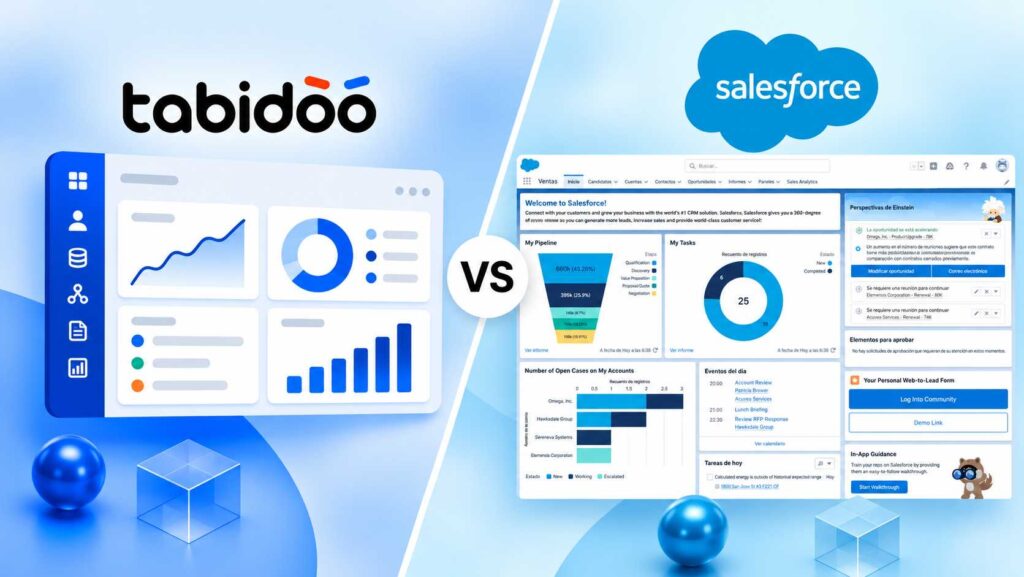
Salesforce is a powerful CRM platform for managing sales and customer relationships. Tabidoo offers a more flexible alternative for companies that want to build custom applications, tailor workflows to their needs, and manage business data without per-user fees. The right choice depends on your company’s requirements, the features you need, and your budget.
Tabidoo is a better choice for companies that want to tailor their software to their processes, connect business data, and automate everyday operations. Trello primarily focuses on visual task and project management, while Tabidoo allows businesses to build custom applications that support the needs of different departments.
Tabidoo is a better choice than Zapier for companies that want to do more than automate workflows and need custom business applications to manage their processes in one place. Zapier primarily focuses on automating tasks and connecting existing apps. Tabidoo allows you to build tailored applications, manage business data, and automate processes within a single platform.
Tabidoo is a better choice than Freelo for companies that need to manage not only projects and tasks, but also customers, orders, approvals, and other business processes. Freelo is a Czech project management tool focused on team collaboration, task management, and time tracking. Tabidoo is a no-code/low-code platform that lets you build connected business applications tailored to the way your company operates.