
Workflow automation
Published May 31, 2026
What works for a five-person team may not work for a company with dozens of employees. As organizations grow, new processes emerge, departments expand, and coordination becomes more complex. Both Monday and Tabidoo help businesses gain greater visibility and control. However, each platform approaches the challenge from a very different perspective.
Author Tabidoo
7 minutes to read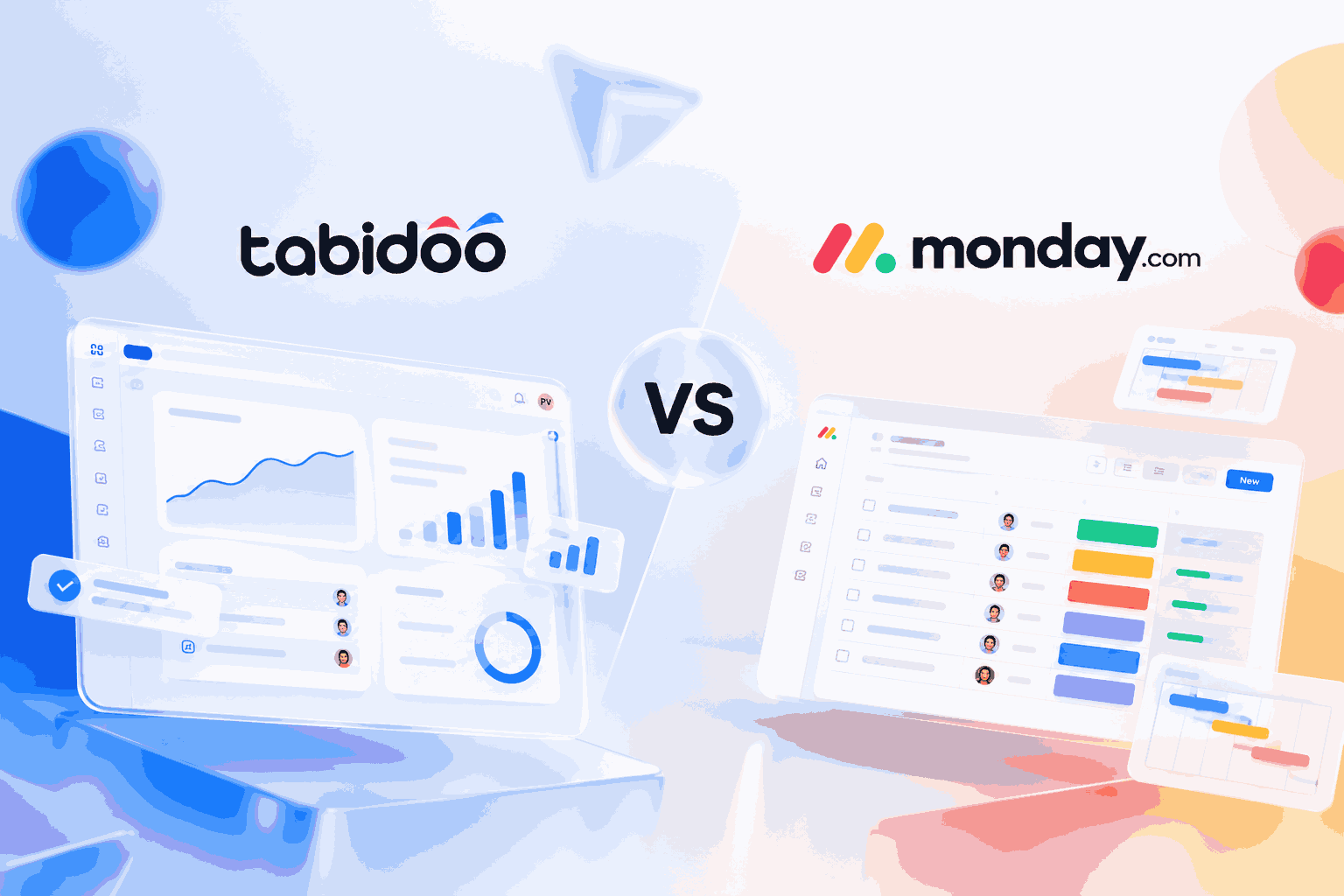
What works for a five-person team may not work for a company with dozens of employees. As organizations grow, new processes emerge, departments expand, and coordination becomes more complex. Both Monday and Tabidoo help businesses gain greater visibility and control. However, each platform approaches the challenge from a very different perspective.
Monday is one of the world’s best-known work management and team collaboration platforms. Since its launch, it has focused on one core objective: helping organizations gain better visibility into who is working on what, how projects are progressing, and where bottlenecks occur.
Its intuitive interface has made it popular among marketing teams, agencies, IT companies, startups, and enterprises alike. Users can plan projects, assign tasks, track deadlines, and manage team capacity through dashboards, Kanban boards, timelines, and calendars.
Over time, Monday has expanded into areas such as CRM, marketing operations, and customer support. However, its primary strength remains project and work management.
Tabidoo is a Czech low-code platform that enables companies to build custom business applications without programming.
Organizations often start with CRM, project management, or recruitment processes. Over time, they add customer support, helpdesk management, approval workflows, asset management, service operations, and internal workflows.
One of Tabidoo’s biggest advantages is the ability to connect multiple business functions within a single system. Information is not scattered across different applications, and teams work with the same data without relying on complex integrations.
Thanks to its low-code approach, companies do not have to wait for software vendors to develop new features. They can continuously adapt and expand their solutions as business needs evolve.
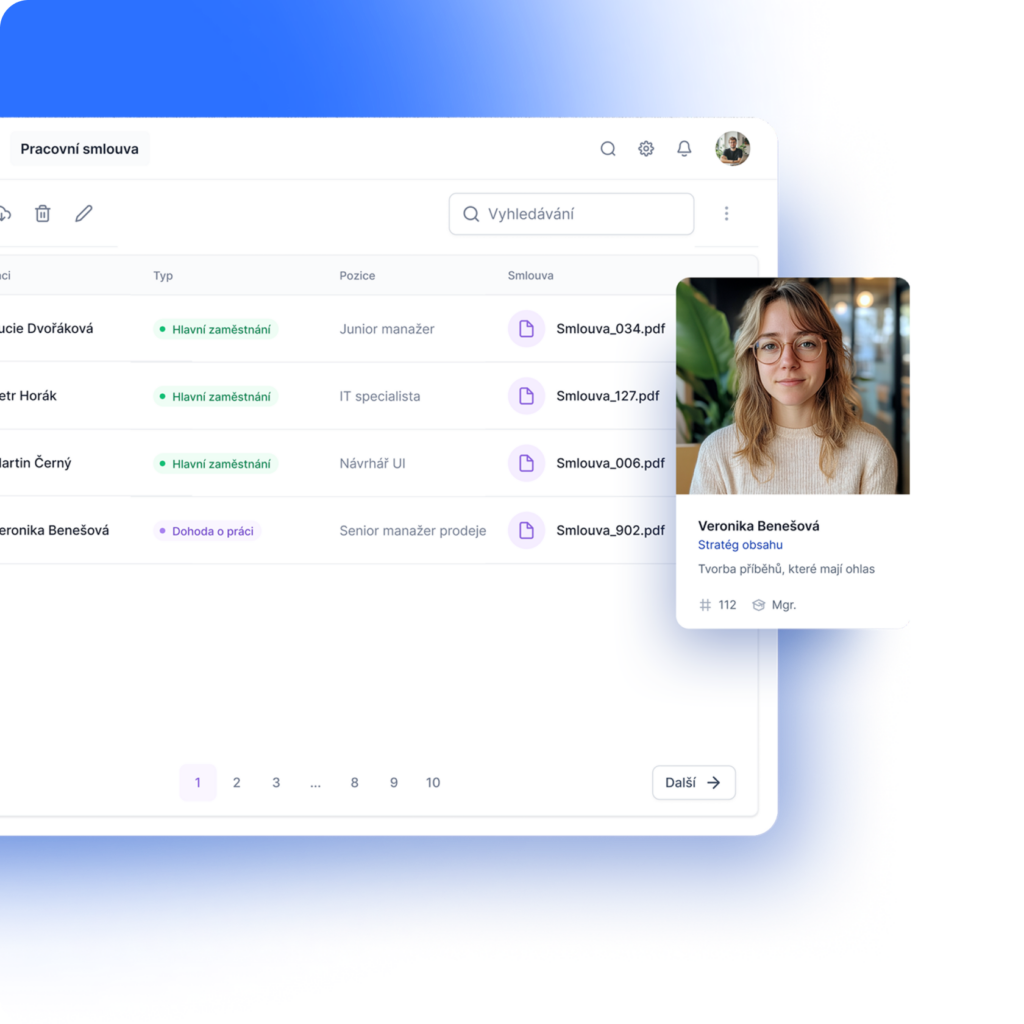
Monday was created to help teams plan, organize, and coordinate work more effectively. Tabidoo was created to help companies digitalize the way they operate.
At first glance, the distinction may seem subtle. In practice, however, it significantly affects how businesses use the two platforms. If your goal is to manage projects, tasks, and team capacity, Monday offers an excellent solution. If you want to manage projects while also connecting sales, recruitment, customer support, approvals, and other business functions in a single environment, a platform designed for broader business operations may be a better fit.
This is where Monday truly excels.
If your primary objective is to gain visibility into projects and workload distribution, Monday is one of the strongest solutions available.
Tabidoo also supports project management, but approaches it as part of a larger business ecosystem. Projects do not need to exist in isolation. They can be directly connected to sales opportunities, customers, documentation, approval processes, invoicing, or service requests.
For companies that want all related information available in one place, this approach can provide a significant advantage.
Monday offers extensive configuration options. Companies can customize boards, dashboards, views, and automations to match their workflows. Tabidoo goes even further.
This means companies are not just customizing an interface—they are designing how the system itself operates.
Many businesses begin with a project management tool. Over time, however, they also need to manage sales, recruitment, customer support, service operations, request tracking, and approval workflows. This is where the difference between a project management platform and a business process platform often becomes apparent.
Monday handles work organization exceptionally well. However, as companies seek to consolidate more operational areas into a single environment, additional tools and integrations often become necessary.
Tabidoo enables organizations to continuously expand their existing system with new business functions without introducing separate applications.
Both platforms provide advanced automation capabilities. Monday focuses on automating project and team-related activities. Tabidoo automates processes across the entire organization.
The result is not just better-managed projects, but smoother business operations overall.
Tasks that once required dozens of hours of manual configuration can now be accelerated significantly with artificial intelligence.
Tabidoo uses AI to assist with application design, form creation, and business logic configuration. Instead of manually setting up every element, users can quickly transform business requirements into functional solutions.
The next step is the ability to create entire applications using natural language. Users simply describe the problem they want to solve, and the platform generates the appropriate data structure, screens, and workflows.
This gives businesses greater independence, faster response times, and the ability to adapt their systems at the same pace as their organization evolves.
Most companies do not start worrying about software costs when implementing their first system. They start paying attention when they add a second, third, and fourth one. Monday offers several pricing tiers based on features and user counts. For project management and team coordination, this provides a straightforward pricing structure that scales alongside the organization.
Tabidoo takes a different approach. Companies do not pay for every individual user. Instead, pricing is based on the platform license and the scope of the solution being used. This allows organizations to involve sales, management, HR, and other teams without licensing costs increasing for every new employee.
However, the biggest difference often appears elsewhere.
While Monday is frequently one of several tools used within a company, Tabidoo enables businesses to build multiple functions within a single environment. For many organizations, the key question is not how much one system costs, but how many systems they need in total.
Monday was originally designed to organize work. When companies need to connect multiple business functions and build a unified operational system, additional tools or extensive integrations are often required.
Tabidoo offers extensive customization and expansion possibilities.
Organizations are not limited by a predefined structure and can continuously adapt the platform to their needs.
As a result, it delivers the greatest value to companies that want to actively improve and digitalize multiple areas of their operations.
Monday is one of the strongest solutions available for project management and team coordination. If your goal is to gain greater control over tasks, deadlines, and resource planning, it is an excellent choice.
However, when sales, customer support, recruitment, service operations, and other business functions become equally important, managing work alone is no longer enough.
The challenge becomes connecting all parts of the organization into a unified system. This is where Tabidoo offers significantly broader possibilities. Instead of a standalone project management tool, you gain a platform on which you can build your own business system and continuously expand it as your organization grows.
Workflow automation
Reports
Multilingual
Quick setup, zero risk, full control.
No trial limits
No user fees
No credit card required
Quickbase is a mature enterprise platform for dynamic work. Tabidoo offers a focused process foundation, full AI support, an MCP server, ISO certification and unlimited users in a simpler commercial model. Where does each platform have the real advantage?
Bubble and Tabidoo both let teams build applications without traditional development, but they start from different places. Bubble gives product builders a flexible canvas. Tabidoo turns business data and processes into a governed system with full AI support and an MCP server. Which approach fits your goal?
Zoho Creator offers a broad low-code ecosystem, native mobile applications, AI and a large integration catalogue. Tabidoo combines full AI support, MCP, ISO certification, PWA, direct integrations and unlimited users in a more focused platform. Which approach fits your organisation?
Base44 and Tabidoo both put AI at the centre of application creation. Base44 excels at speed and visual impact. Tabidoo combines full AI support with governed business data, ISO certification, PWA and an MCP server for agents working with live applications. Which approach is stronger?