
Workflow automation
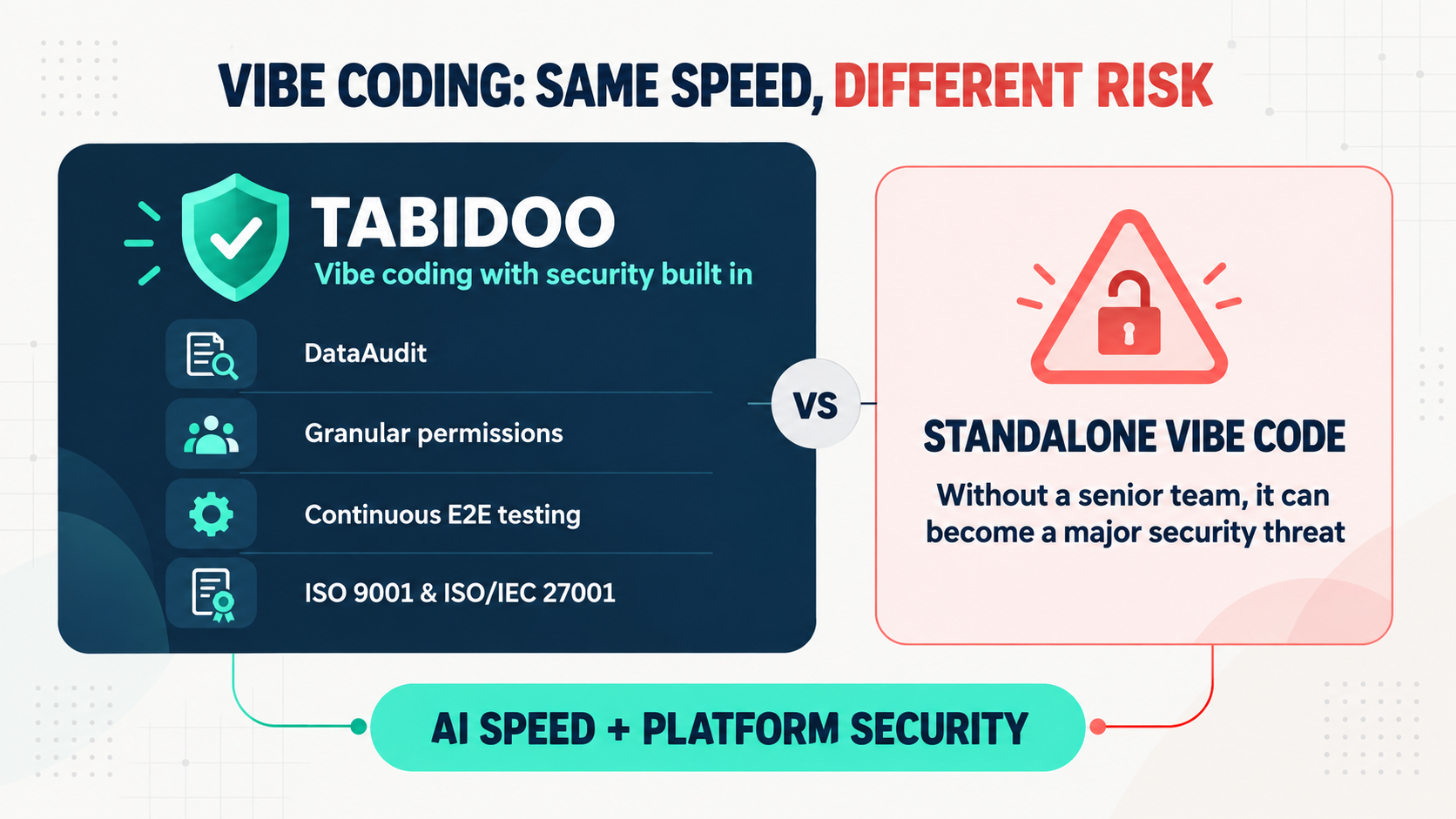
Vibe coding is transforming the speed at which applications can be built. Speed alone, however, does not guarantee security. Tabidoo combines AI-assisted creation with a platform architecture designed to protect data, control access, track changes and continuously verify system behavior.
Vibe coding is changing how new applications are created. Users no longer need to know exactly how to program every feature. They can describe the outcome they need, while AI helps create the data model, forms, automations or user interface.
What once took weeks can now take hours. Security mistakes can be introduced just as quickly.
An application is not secure simply because it works. It must protect data correctly, control access, record changes and remain secure after future modifications. This is where the difference between standalone vibe coding and building on a platform with security at its foundation becomes clear.
AI can create a functional application remarkably quickly. On its own, however, it cannot guarantee that every security scenario has been handled correctly.
Who can view a specific record? Who is allowed to change a sensitive field? Can an external partner see only the data relevant to them? What happens when someone bypasses the user interface and attempts to access data through an API? Can you determine who changed an important value after the event?
These questions rarely become visible during the first application demo. They appear when more people start using the system, real company data is introduced or the application becomes part of a critical business process.
When a standalone vibe-coded application is not delivered and reviewed by a highly experienced team, it can become a major security threat. It may look complete on the surface while hiding overly broad permissions, insufficiently protected interfaces, missing audit trails or vulnerabilities that a later rapid change can accidentally reintroduce into production.
Tabidoo applications run on a unified platform that handles essential security mechanisms centrally. Creators do not start with an empty file, and they do not have to redesign every basic layer of protection for each new application.
This is critical for secure vibe coding. The user and AI can focus on data, processes and required functionality, while Tabidoo provides the shared security foundation on which the resulting application operates.
One of Tabidoo’s core security capabilities is DataAudit. Data changes are automatically recorded together with information about who made them and when they occurred.
The audit trail helps answer practical questions:
DataAudit is more than an incident investigation tool. It supports accountability, business process control and compliance requirements. When automations and AI work with business data, traceability becomes even more important than it is in a fully manual process.
Learn more about security and audit data in Tabidoo
A simple split between administrators and regular users is rarely sufficient for a business application. Tabidoo therefore enables much more detailed permission management.
Access can be assigned through roles and restricted at application, table, field and individual-record level. A user can view or edit only the data they genuinely need. Sensitive values can remain hidden even when that person has access to other parts of the same application.
This supports the principle of least privilege: every user, automation and integration should receive only the permissions required to perform its task.
The same principle can be applied to API tokens. An integration does not have to inherit all the permissions of its creator. It can operate under a dedicated role with precisely defined access.
A security mechanism is valuable only if it continues to work after the next update. Alongside other controls, Tabidoo uses continuously running end-to-end tests to verify the platform through realistic user scenarios.
These tests examine how the different layers of the system work together and help identify regression issues early. A new feature or platform change is not evaluated only in isolation. It must also avoid breaking behavior that already works.
For larger customer applications, Tabidoo also recommends separate DEV, TEST and PROD environments. New functionality can be created, verified and approved before it reaches real users. The production system does not have to become an experimental workspace.
See the recommended DEV → TEST → PROD workflow
Security cannot rely on marketing claims alone. Tabidoo has obtained ISO 9001 and ISO/IEC 27001 certification.
ISO 9001 relates to quality management systems. ISO/IEC 27001 is the international standard for information security management. It does not assess only one technical feature. It addresses how an organization identifies risk, implements security controls and manages the protection of information over time.
Certification does not mean that a security incident can never occur. It does demonstrate that security and quality are supported by defined and controlled processes rather than relying solely on the intentions of individual developers.
Learn more about Tabidoo’s certifications
Vibe coding opens application development to people who would previously have needed a dedicated engineering team. That is a significant opportunity. It also creates the risk that development speed will exceed the team’s ability to review and secure the result.
A highly senior engineering team can design a secure architecture, implement it correctly and maintain it over time. Without that level of expertise behind a standalone application, seemingly small omissions can become serious risks to corporate and personal data.
Tabidoo offers a different model. Vibe coding does not take place without guardrails on an unverified foundation. It operates within a platform supported by DataAudit, highly granular permissions, continuous end-to-end testing and processes backed by ISO 9001 and ISO/IEC 27001 certification.
The future of business application development should not require a choice between speed and security. Successful platforms need to provide both.
Tabidoo supports vibe coding with security assurances that do not depend solely on the quality of one piece of generated code. They are supported by the architecture of the platform, access control, traceable DataAudit records, continuous testing and certified processes.
Standalone vibe coding can be exceptionally fast. But when the resulting solution is not delivered and reviewed by a highly senior team, it can also become a major security threat.
Tabidoo lets organizations harness the power of vibe coding while keeping security under control.
Workflow automation

Reports
Multilingual
Quick setup, zero risk, full control.
No trial limits
No user fees
No credit card required
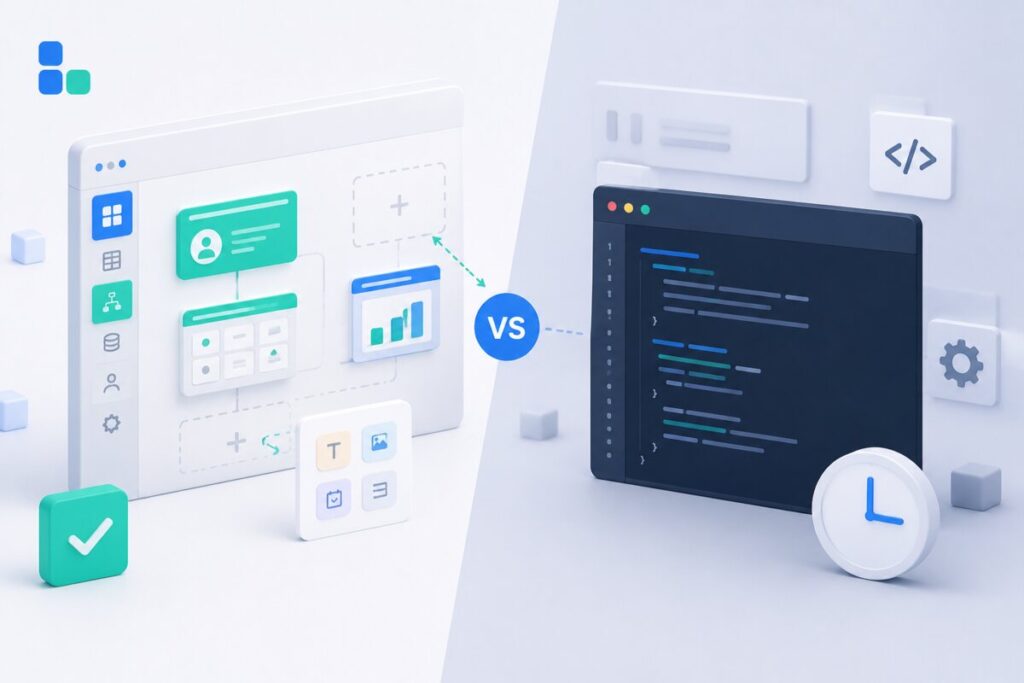
Learn when to build an internal app in Tabidoo – with no per-user fees, flexible workflows, role-based access, audit history, API and custom logic.
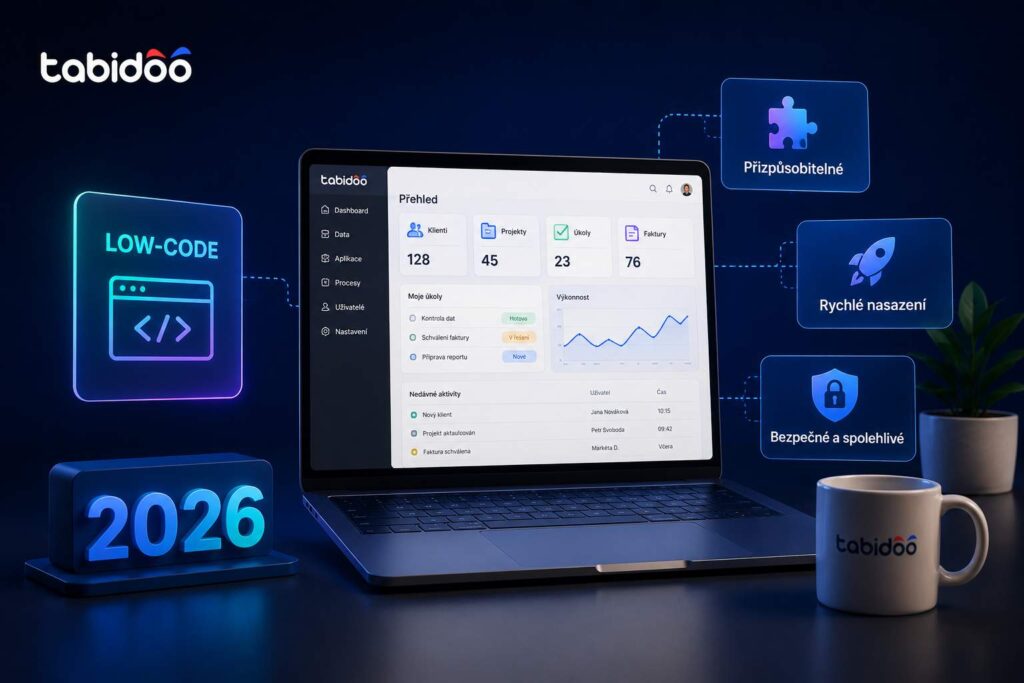
There is no single best low-code platform for every business. In 2026, the right choice depends on how quickly a platform can turn business processes into working applications, how easily those applications can be adapted without coding, and how effectively it uses artificial intelligence throughout both application design and everyday business operations. Among the best-known low-code platforms today are Microsoft Power Apps, Mendix, OutSystems, Appian, Retool, and Tabidoo. Each offers different strengths and is designed for different types of organizations.

Artificial intelligence (AI) will never fully replace well-designed business processes, reliable data, employee accountability, strategic decision-making, or company know-how. On the other hand, it can significantly accelerate routine tasks, data analysis, information retrieval, content creation, and administrative work.

The fastest way to speed up invoice approval is to digitize the entire approval process. Instead of forwarding emails, searching for documents, or making phone calls, companies can implement an automated workflow in which every invoice follows predefined approval steps. This allows businesses to reduce approval times from days to hours, gain full visibility into every invoice, and significantly reduce errors.