
Workflow automation
Published July 8, 2024
In today’s age of rapid technological advancement, low-code platforms such as Tabidoo offer an effective solution for developing applications with minimal programming knowledge. This paper will explore which types of applications are ideal for low-code platforms, such as CRM systems or applicant tracking systems (ATS), and conversely, which types of applications might require traditional development approaches due to specific requirements for technical processing, performance, or interactivity. Learn how to effectively leverage low-code platforms for rapid application deployment and when it’s better to choose other development methods.
Author Tabidoo
5 minutes to read
Low-code platforms are development environments that allow users to create applications with minimal need to write code. These platforms provide graphical user interfaces and various tools that make application development easier even for those without deep programming knowledge. A key feature of low-code platforms is their ability to speed up the development process and enable the creation of applications at less cost and in less time.
Graphical User Interface: Low-code platforms provide visual interfaces for application design. Often in the form of drag-and-drop editors that facilitate the design of user interfaces and application logic. Automation of common tasks: these platforms offer pre-packaged components and modules that can be easily integrated into applications, eliminating the need to write code for common tasks. Rapid development: they enable faster application development by using predefined templates and modules. Scalability: Low-code platforms are designed to support the growth and scaling of applications according to user needs. Integration: good low-code platforms offer a wide range of integration options with other systems and databases.
Low-code platforms are particularly suitable for developing certain types of applications that rely on standardized processes and have clearly defined functionality. I will give some examples where using a low-code platform like Tabidoo is ideal:
Customer Relationship Management (CRM) systems: these customer relationship management systems are a common example of applications that can be effectively built on a low-code platform. CRM systems often require standard functionality such as contact management, interaction tracking, business opportunity entry and tracking, and reporting. Tabidoo and similar platforms offer modules and templates that can be quickly adapted to an organization’s needs without deeply interfering with the code.
ATS (Applicant Tracking System): systems for managing the recruitment process of job applicants can also be successfully implemented on low-code platforms. These systems require candidate data management, process automation to track the progress of the selection process. And integration with other HR systems. Low-code platforms can facilitate rapid implementation and customization to meet the current requirements of the HR department.
Internal management and reporting tools: Many companies need internal tools for resource management, project tracking, or financial reporting. Low-code platforms allow for rapid deployment of such tools with the ability to easily update and modify them according to changing business processes.
Although low-code platforms offer many advantages, there are types of applications for which they may be less suitable:
Highly specialized technical applications: applications requiring deep technical integration, specific algorithms, or advanced data manipulation (e.g., machine learning applications, complex simulations). Often go beyond the standard capabilities of low-code platforms and require traditional development approaches.
Games and highly interactive applications: development of games and applications that require complex user interactions, graphics, and client-side performance can be limited or inefficient on low-code platforms.
Conclusion Low-code platforms are a powerful tool for accelerating application development and enabling a broader approach to software development. Tabidoo is a clear example of a low-code platform due to its intuitive interface and ease of use. On the other hand, the Microsoft Power Platform, despite its broad capabilities and capabilities, may be more technically challenging for some and may not fully meet the definition of a low-code platform. Thus, any classification depends on the particular perspective and use of these tools.
Workflow automation

Reports
Multilingual
Quick setup, zero risk, full control.
No trial limits
No user fees
No credit card required

Recent PHP security vulnerabilities have raised concerns about the security of websites and applications. What’s happening, who is affected, and why can Tabidoo users continue working without worrying about these specific vulnerabilities?

Excel is no longer enough for your business when managing spreadsheets takes more time than actually working with the data. Common warning signs include duplicate information, manual data entry, disorganized order management, complicated approval processes, and reporting that depends on a single employee. If spreadsheets have become the main tool for managing your business processes, it may be time to switch to a connected business application like Tabidoo.
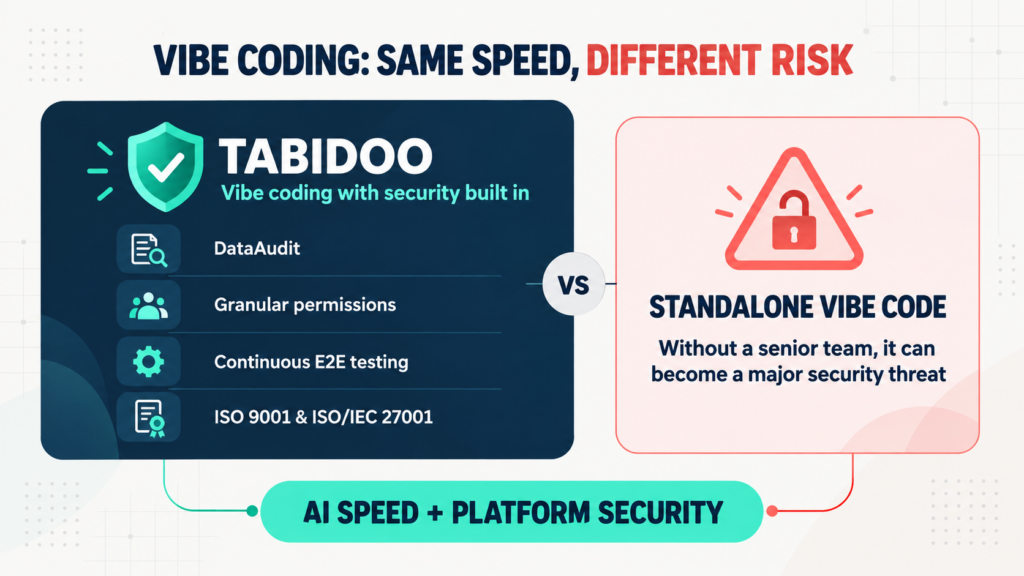
Vibe coding delivers speed, but not automatic security. Tabidoo combines AI with DataAudit, granular permissions, continuous E2E testing and certified processes.
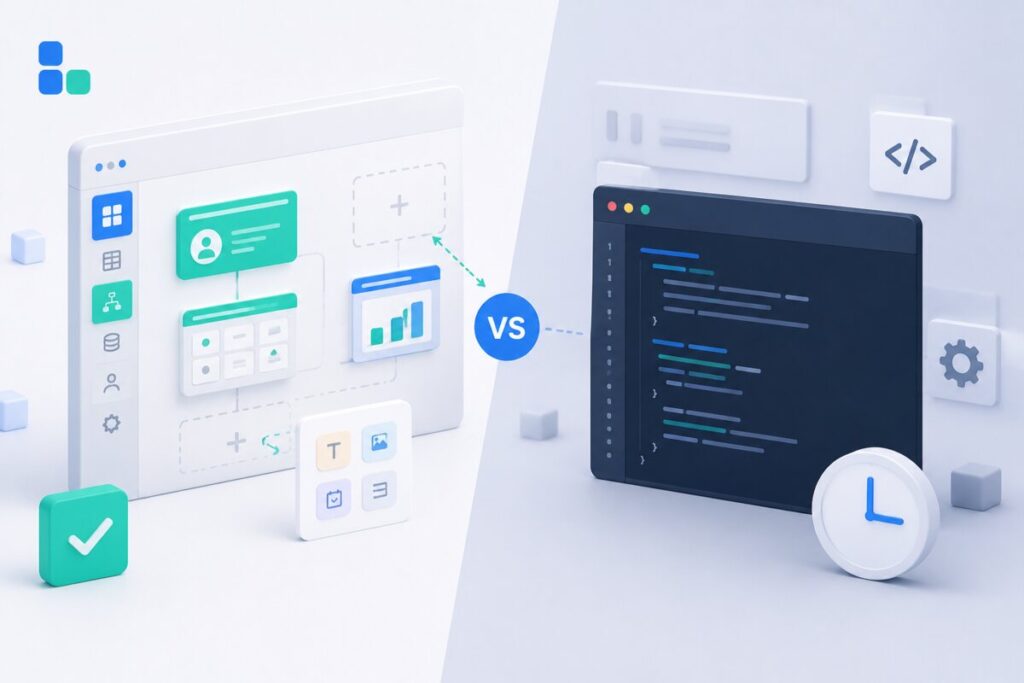
Learn when to build an internal app in Tabidoo – with no per-user fees, flexible workflows, role-based access, audit history, API and custom logic.