
Workflow automation
Published September 30, 2026
What happens when your existing software still works, but your business is starting to outgrow it? That was exactly the challenge facing CNC Doctors. Together with BohuTech, the service company set out to build its own business management system using the Tabidoo platform. The first usable version was ready in approximately one month. And instead of waiting for the next major software update, users can now test new features directly and refine them based on their actual needs.
Interviewee Ing. Jiří Bohuslav, BohuTech
9 minutes to read
„We didn’t just want to replace our existing software. We wanted to create a system that would grow alongside the company, adapt to our processes, and allow us to handle more service jobs without unnecessary administrative work.”
Fourteen people, CNC machine servicing, and daily operations where accurate information makes all the difference. CNC Doctors provides fault diagnostics, repairs, on-site servicing, and technical support. Five office employees coordinate business operations, while nine service technicians take care of customers and their machines.
To keep everything running smoothly, the team needs a clear overview of service jobs, requests, completed work, documentation, and subsequent invoicing.
The original software wasn’t bad. In fact, it handled service job records and invoicing well. The problem emerged whenever the company needed to change something. Every new feature required communication with the software provider, detailed specifications, and waiting for the result. Technical limitations made further development even more complicated.
And there was another catch: How do you accurately describe a feature you’ve never actually seen?
Users often knew exactly what was missing from their daily work. But only after trying a specific solution could they explain precisely how it should function. On top of that, the company relied on several separate tools: Google Calendar, phone contacts, emails, documents, and various standalone records. Each served its purpose, but information remained scattered across different places.
Administration itself wasn’t a major issue. The company already had it under control.
What was missing was the ability to connect individual processes, gain a complete and up-to-date overview, and continue growing without being restricted by its existing software.
The collaboration with BohuTech began when the owner of CNC Doctors requested an analysis of the company’s business processes and potential opportunities for further development. The analysis revealed that a more flexible information system and centralized business data would be essential for future growth. Several solutions were considered, including specialized software designed for service companies.
Tabidoo was initially just one of the options. Ultimately, the decision came down to a combination of the platform’s flexibility, the implementation partner’s understanding of business processes, and mutual trust.
The ability to quickly build a working solution and continuously improve it based on user feedback also played an important role.
Rather than starting with an extensive technical specification, BohuTech first mapped how the company actually operated, including individual activities, the data they generated, and the connections between them.
After several joint meetings, the team developed an initial data model and outlined the tables and processes that would form the foundation of the new system. The goal wasn’t simply to move existing records into a more modern environment. It was to create a better way to run the business.
One of the biggest advantages of the chosen approach was how quickly development could begin. The first usable version of the system was created in approximately 30 days.
During the initial phase, BohuTech built the core data model, tables, and relationships between individual records, without extensive automations or complex workflows.
The next step was introducing features that would simplify users’ everyday work.
The system gradually gained automatic field population, data transfers between related records, service report preparation, and record status checks.
Tabidoo also makes it possible to trigger follow-up processes after a service report is approved and prepare the information needed for subsequent processing. Importantly, much of the original logic for managing service jobs and invoicing was preserved.
The new solution expanded these capabilities with better handling of attachments, photographs from service visits, documentation, and related records.
This iterative approach became one of the project’s greatest advantages. Instead of spending weeks explaining requirements, users received working features they could immediately test.
Their practical experience then shaped subsequent improvements. According to the implementation partner, changes needed for everyday system use can, in most cases, be introduced within 24 hours of an issue being reported.
What previously required detailed specifications and lengthy communication with a software provider can now be addressed directly within the working application. The original implementation plan anticipated approximately two and a half months of intensive work.
However, as users began working with the system, they identified additional requirements and opportunities for improvement.
The project therefore expanded beyond its original scope. Not because the solution wasn’t working, but because users kept discovering new ways it could make their work easier.
The result is an evolving business information system that connects the main areas of CNC Doctors’ operations. The system already includes, or is gradually being expanded to include, everything from CRM and customer contacts to service requests, service jobs, work reports, documentation, invoicing, and management dashboards.
Service technicians can work with information about service visits, faults, completed activities, and related documentation. The office team benefits from better-connected information for coordinating jobs and handling subsequent administrative tasks.
Meanwhile, company management is gradually gaining a more comprehensive view of business operations.
Completed parts of the system are already being used or tested in everyday operations. User training took place online and, according to the implementation experience, was completed quickly. Users described the system’s everyday interface as intuitive.
Although the system continues to evolve, its initial benefits are already visible.
Information about customers, service jobs, and service activities is gradually being consolidated. This reduces the company’s dependence on separate tools and disconnected records.
Service requests, reports, documentation, and related records can share information without unnecessary manual re-entry.
Centralized data provides the foundation for more up-to-date information about service jobs, service activities, and overall operations.
New features can be added and adjusted based on user experience without having to rebuild the entire system.
The new information system is being developed with a clear long-term objective: to enable CNC Doctors to handle approximately 2.5 to 3 times as many service jobs and technicians while maintaining a comparable administrative workload.
This new system has already brought CNC Doctors more centralized business data, better-connected processes, and significantly greater flexibility for future development.
The company now has a solid foundation for its planned growth and the gradual expansion of automation, without needing to replace its entire information system.
Development doesn’t end when the system goes live. One of the current priorities is completing a customer portal that will give CNC Doctors’ customers access to relevant information, including service requests, jobs, machines, documentation, and service history. Another important area is more advanced reporting.
The team initially considered integrating an external business intelligence tool. However, after exploring Tabidoo’s capabilities, it became clear that some of the required dashboards and visualizations could be created directly within the platform using custom HTML.
The planned dashboards will allow management to monitor metrics such as the number and status of service jobs, technician workloads, hours worked, invoicing trends, and outstanding requests.
Further automation and the use of Tabidoo AI are also part of the roadmap. Some features are already operational, including automatic document generation and delivery, as well as intelligent data validation.
Other capabilities, such as service history analysis, automated request processing, and using Tabidoo AI with company data, are currently being tested or gradually introduced.
In the longer term, the system could also be connected to predictive maintenance models and used to create service plans.
But all these possibilities depend on something far less glamorous than AI itself. Well-structured data and processes that actually make sense. Because without them, even the most advanced technology has no reliable foundation to work with.
CNC Doctors didn’t need another software solution packed with features they might never use. They needed a system that respected how their business operated while giving them the flexibility to change processes as the company developed.
During implementation, BohuTech combined Tabidoo’s capabilities with its understanding of service, manufacturing, and business processes. This made it possible to address not only forms and records, but also the relationships between them and unnecessary data duplication.
Based on the implementation partner’s experience, the development costs of this solution are estimated at approximately 20% of those associated with certain alternative approaches, including the customer’s internal costs.
The CNC Doctors story demonstrates that a low-code platform can do much more than manage simple records. It can become the foundation of a comprehensive business information system connecting people, data, and everyday operations.
And most importantly, it enables companies to continuously improve what already works.
You don’t have to wait until you can describe every feature of your future system down to the smallest detail. With Tabidoo, you can start with a specific process, build a working solution, and continue developing it based on what you actually need.
Because the best business system isn’t necessarily the one with the most features. It’s the one that helps you keep moving forward.
Workflow automation
Reports
Multilingual
Quick setup, zero risk, full control.
No trial limits
No user fees
No credit card required
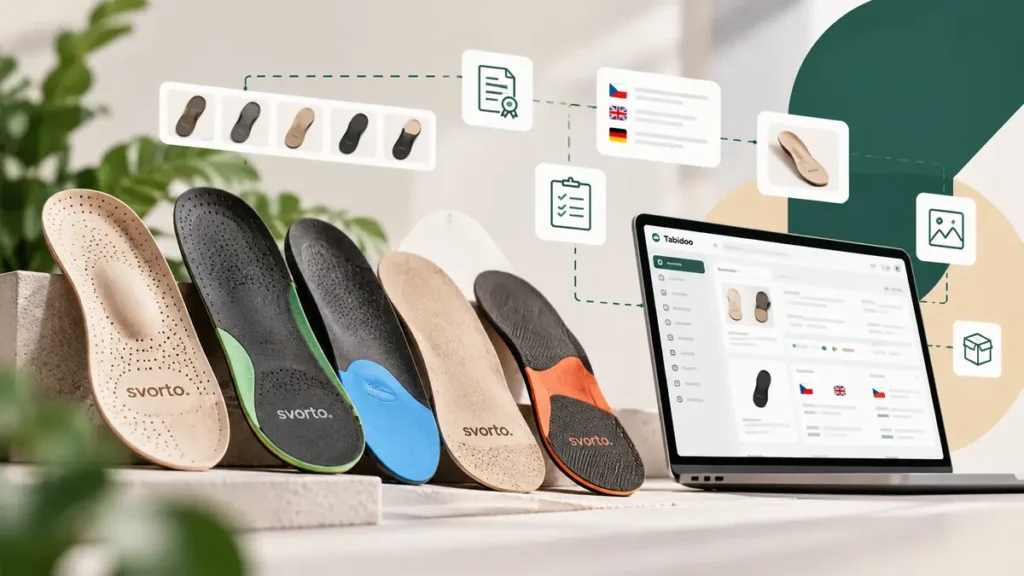
What do orthopedic products, product data, contracts, and employee attendance have in common? At Svorto, the answer is simple: Tabidoo. With more than a century of history behind it, this family-owned company teamed up with Emberix to embark on a digital transformation journey. What started with scattered product data is gradually changing the way the entire company operates. The result? Centralized data, streamlined processes, and a system that adapts to the company's needs. Not the other way around.

At the Spejbl and Hurvínek Theatre, the action doesn’t stop at the stage. Behind the scenes, there are contracts, orders, budgets and approvals to manage. Tabidoo brought these processes together in one place, cut approval times from days to minutes or hours, and saved dozens of hours of admin work. Because the less time paperwork takes, the more time there is for theatre.

For nearly ten years, Z-AGENCY ran on Google Sheets. Sales, HR, and inventory. It worked. Until the company grew to the point where spreadsheets started slowing things down instead of helping. Today, Z-AGENCY manages nearly 5,000 business cases in Tabidoo, coordinates more than 60 external collaborators, runs inventory for hundreds of events a year – and uses the same data for automation and AI.
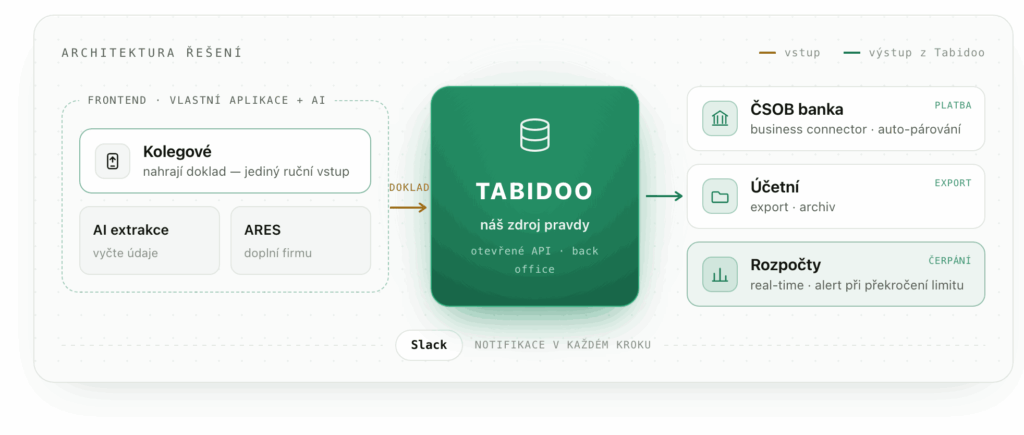
Invoice approval doesn’t have to mean dozens of emails, manual data entry, or endlessly searching for who has the invoice next. At Make more, they built a custom solution in Tabidoo that manages the entire process – from receiving an invoice to posting it into the accounting system.