
Workflow automation
Published July 24, 2026
Bubble and Tabidoo both let teams build applications without traditional development, but they start from different places. Bubble gives product builders a flexible canvas. Tabidoo turns business data and processes into a governed system with full AI support and an MCP server. Which approach fits your goal?
Author Tabidoo
9 minutes to read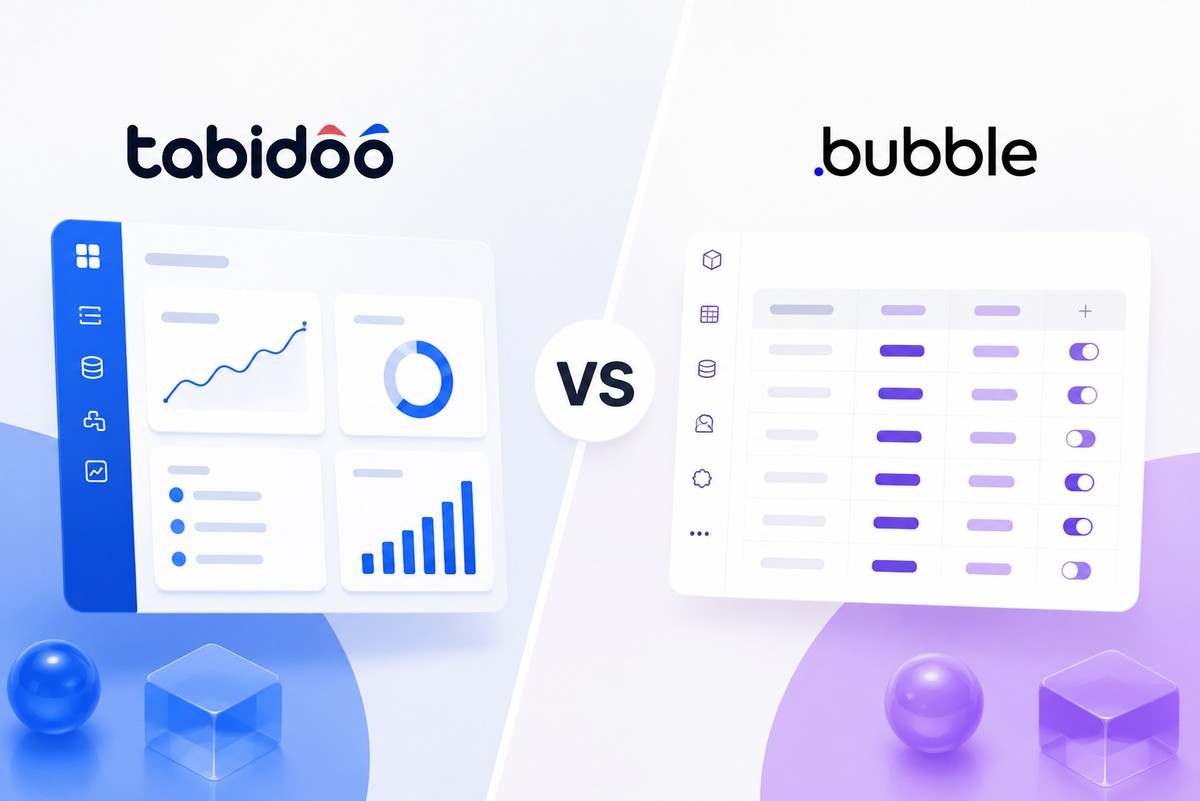
At first glance, the promise looks similar: describe, configure and launch an application without a conventional development project. In practice, Bubble and Tabidoo sit on opposite sides of one important decision.
Bubble starts with the interface and the customer experience. It gives creators a canvas for a SaaS product, marketplace, customer portal or native mobile app. Tabidoo starts with business data and processes. It connects customers, projects, employees, documents, approvals and automations in a system that can be used across an organisation.
The useful question is not: „Which platform has more features?” It is: „Are you creating a product for a market, or an operating system for your company?“
| If you need… | Stronger choice | Why |
| A SaaS product, marketplace or highly custom customer app | Bubble | Greater control over UI and customer journeys |
| CRM, HR, help desk, approvals or operational records | Tabidoo | Business data, roles, audit and workflows are first-class concepts |
| Native distribution through the App Store and Google Play | Bubble | Native mobile and web can share the same backend; Tabidoo offers PWA |
| Tens or hundreds of internal users | Tabidoo | Plans do not charge per user |
| AI agents working with live business processes | Tabidoo | Full AI layer plus a dedicated MCP server |
| Hybrid or on-premises deployment | Tabidoo | EU cloud, hybrid and fully on-premises options |
| Pixel-level freedom over a public product | Bubble | Flexible visual editor and a broad plugin ecosystem |
Bubble is a no-code platform for building full web and mobile products. It combines visual interface design, a database, application logic, workflows, hosting and external services. A team can create everything from sign-up and payments to customer accounts without assembling a separate frontend, backend and infrastructure stack.
Its defining strength is freedom. Creators are not limited to standard data tables and forms: they can design custom pages, interactions and customer journeys. That makes Bubble attractive to start-ups, product teams, agencies and founders validating or operating a digital product.
Tabidoo is a European low-code platform for business applications and process digitalisation. Its foundation includes relational data, forms, roles, record-level permissions, full audit history, dashboards, workflow automation and programmable extensions.
Teams use it to build CRM, recruitment, help desk, asset management, contract management, service, project and approval systems. Applications can share the same data model, so a closed opportunity can create a project, generate a document, start an approval and hand work to another department.
Tabidoo supports EU cloud, hybrid and fully on-premises deployment. It is certified to ISO/IEC 27001 for information security management and ISO 9001 for quality management. It also supports PWA delivery.
AI is embedded across the platform. It helps create and modify applications, forms, widgets, dashboards, workflows and scripts. Tabidoo’s MCP server lets compatible AI clients and agents work with permitted data and supported operations. AI can therefore help build the system and become a natural-language interface to the running application.
Bubble resembles a digital studio. It provides capable tools and wide freedom, while the result depends on how well the creator designs the interface, data model, workflows, privacy rules and application operations.
Tabidoo resembles a construction kit for business systems. Relational tables, forms, roles, audit trails, imports, exports, reports and automation are native building blocks. The UI is less “anything goes,” but teams can reach a secure and maintainable operational application faster.
For Bubble, the main object is the product experience. For Tabidoo, it is the relationship between data, people and process. That difference shapes nearly every trade-off.
Bubble has the natural advantage when design itself is part of the competitive proposition. Unique navigation, animations, public pages and bespoke onboarding all benefit from its visual freedom.
Tabidoo optimises for productive work. It offers tables, forms, Kanban, calendars, Gantt views, dashboards and custom HTML widgets. Applications can be branded and adapted, but the priority is efficient data and process handling rather than designing every pixel from scratch.
For a customer-facing digital product, Bubble will often be the stronger choice. For an internal application where permissions, audit, speed of change and consistent data matter most, Tabidoo is usually the more direct route.
Bubble uses workflows as application logic. A click, sign-up, payment or data change can trigger a sequence of actions. This flexibility works particularly well for product scenarios.
Tabidoo uses workflows to orchestrate business operations: a status change creates a project, an expiry date sends an alert, an approval generates a document, or an event hands data to another system. Teams can build direct integrations through the REST API and event-driven workflows that call external services and process their responses. Make and Zapier connectors provide a faster no-code route.
Bubble automates product behaviour. Tabidoo automates the relationships between data, roles, systems and departments.
Bubble combines prompting with its visual editor and positions AI as a co-builder for web and mobile products. It is a strong approach for generating a product and refining its interface.
Tabidoo applies AI throughout the life cycle of a business application. It can help define and change the application, create form behaviour, custom widgets, dashboards, workflows and scripts, and work with the context of the data and process model.
The MCP server is the differentiator. Compatible AI assistants and agents can access authorised data and perform supported operations. A user can ask what is happening in sales, find a record or initiate an action without navigating through each form.
Bubble remains stronger for generating a highly bespoke product interface. Tabidoo moves to the front of the field when AI must build, evolve and operate a governed business system.
Bubble provides managed cloud hosting, privacy rules and platform security. Its Enterprise offering adds tailored capacity, support and deployment options.
Tabidoo is certified to ISO/IEC 27001 and ISO 9001. These certifications complement role-based and record-level permissions, complete audit history, encrypted transport, backups and GDPR-oriented controls. Customers can choose an EU cloud, hybrid architecture or a fully on-premises installation.
If the application must run inside the customer’s own infrastructure, the distinction is clear: Tabidoo supports that model, while Bubble is a managed cloud platform.
Tabidoo supports PWA, allowing users to install a responsive app experience on supported devices. This is a practical route for internal mobile access without building a separate client.
Bubble has the stronger proposition when the goal is a fully native consumer product distributed through Apple’s App Store or Google Play. PWA and native mobile solve different requirements, so distribution, device integration and offline expectations should be tested explicitly.
Bubble prices each project and its plan rather than charging for every end user. Runtime demand is measured through workload units, while higher plans add capacity, development branches, logs and editors. That can work well for a customer product, but cost follows the application’s operational load.
Tabidoo prices an organisation by usage dimensions such as applications, records, storage, API and workflow. The number of users is unlimited across plans. For an internal system serving sales, HR, management, branches and occasional external collaborators, that creates a predictable expansion path.
Implementation, governance and future change matter more than the subscription alone. Bubble can reduce the effort required to build a unique product. Tabidoo can reduce the effort required to standardise and operate connected business processes.
Bubble is an excellent choice for someone who wants to create a digital product. Tabidoo is the stronger choice for an organisation that wants to digitalise its operations and make them AI-ready.
Choose Bubble when a distinctive public interface, native product experience and visual freedom come first. Choose Tabidoo when connected data, permissions, approvals, automation, ISO-certified management systems, flexible deployment and unlimited users matter more.
The best platform is not the one with the longest feature list. It is the one whose underlying philosophy matches the problem you actually need to solve.
Yes. Bubble can build internal applications, but the team must design the interface, permission model and standards. For common process applications, Tabidoo is usually a faster route to a maintainable result.
Yes, using roles, public forms, a custom domain, API and tailored widgets. If the product requires a completely bespoke public experience, Bubble offers more visual freedom.
Yes. Tabidoo is certified to ISO/IEC 27001 for information security management and ISO 9001 for quality management.
Yes. Tabidoo supports PWA installation on supported devices. Bubble is stronger when a fully native App Store or Google Play product is required.
Direct integrations can use the REST API and workflows. Make and Zapier connectors provide no-code alternatives, while JavaScript and MCP cover programmable and AI-agent scenarios.
Start without a payment card, a time-limited trial or per-user licences. Build your first business application with AI and see how MCP can open approved data and processes to intelligent assistants.
Workflow automation
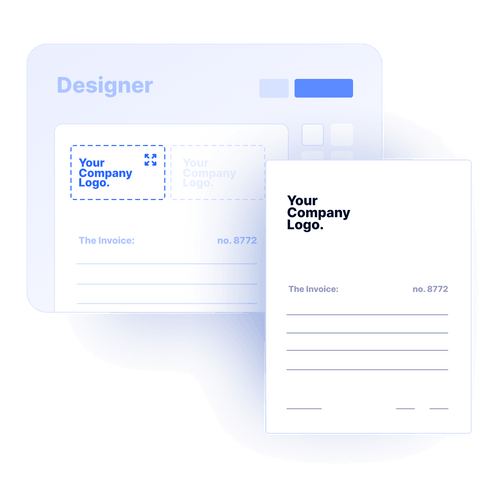
Reports
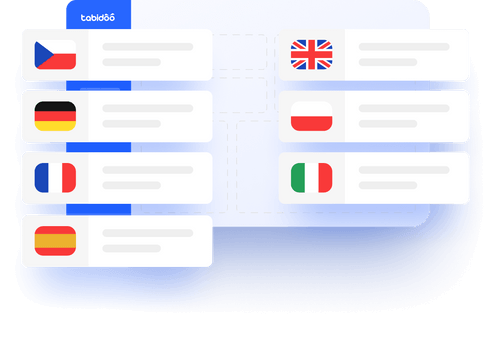
Multilingual
Quick setup, zero risk, full control.
No trial limits
No user fees
No credit card required
Quickbase is a mature enterprise platform for dynamic work. Tabidoo offers a focused process foundation, full AI support, an MCP server, ISO certification and unlimited users in a simpler commercial model. Where does each platform have the real advantage?
Zoho Creator offers a broad low-code ecosystem, native mobile applications, AI and a large integration catalogue. Tabidoo combines full AI support, MCP, ISO certification, PWA, direct integrations and unlimited users in a more focused platform. Which approach fits your organisation?
Base44 and Tabidoo both put AI at the centre of application creation. Base44 excels at speed and visual impact. Tabidoo combines full AI support with governed business data, ISO certification, PWA and an MCP server for agents working with live applications. Which approach is stronger?
What works for a five-person team may not work for a company with dozens of employees. As organizations grow, new processes emerge, departments expand, and coordination becomes more complex. Both Monday and Tabidoo help businesses gain greater visibility and control. However, each platform approaches the challenge from a very different perspective.